
Climate change and environmental pollution are closely linked and have recently become a major challenge not only for Lithuania but also for societies around the world. Currently, the most promising technology for removing ultrafine particulate matter (UFPM) from the exhaust gas of stationary fossil fuel and biomass combustion boilers is electrostatic precipitators, which effectively trap UFPM larger than 2.0 μm in diameter, while the removal efficiency for smaller particles is very low [1]. Acoustic agglomeration is the agglomeration and growth of fine particulate matter in exhaust gas into larger particles by sound waves of high intensity and frequency [2, 3]. UFPM penetrate deep into the human respiratory tract and can therefore have significant effects on human health. The efficiency of conventional devices in removing UFPM is quite low. Therefore, it is crucial to develop technologies for primary removal of UFPM before the electrostatic precipitator (ESP).
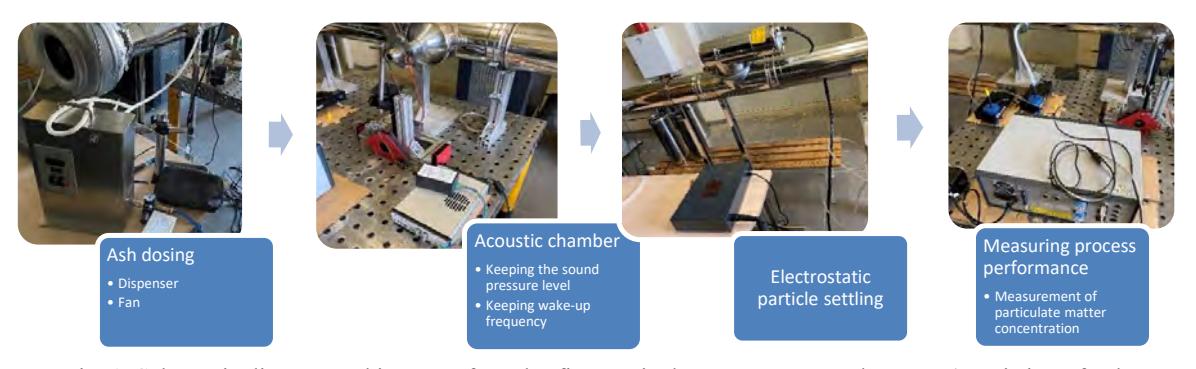
This paper was aimed at investigating the effects of a newly developed acoustic flow generator for the acoustic agglomeration of particles, which incorporates a number of improvements in its design, on the effect of grazing waves on the agglomeration of ash particulate matter. The use of an acoustic flow generator in combination with the ESP increases the separation efficiency of UFPM. A schematic representation of the developed stand with views is shown in Fig. 1. The results of the UFPM concentration research are shown in Fig. 2.
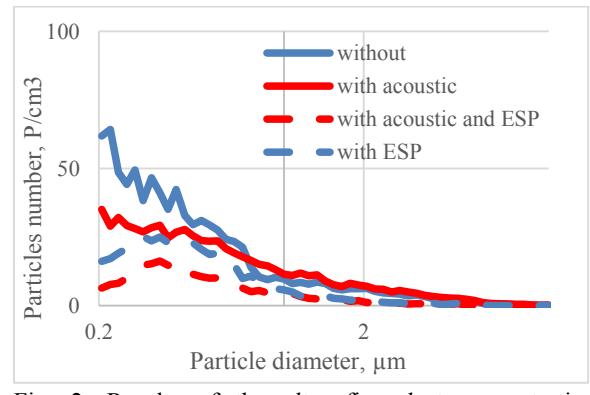
The analysis of the measurement results obtained, which are shown in Fig. 2, shows that the acoustic effect significantly reduces the UFPM number with a diameter of up to 0.75 μm and correspondingly increases the UFPM number with a diameter of more than 0.75 μm. These results lead to an improved separation efficiency of particulate matter using the ESP.
Tests with a newly developed air purification system, which is the subject of this article, have shown that the average filtration efficiency of the system (in terms of filtration of UFPM up to 0.75 μm in diameter) is increased from 42.3% to 69.1% before the use of ESP using acoustic agglomeration-based pretreatment technology.