
Polyurethane (PUR) adhesives are widely used in various industries for their high performance and versatility. PUR are composed of soft segment (a polyether or polyester polyol) and hard segment (diisocyanate and chain extender). The soft segment provides elasticity, whereas the hard segment increases strength and rigidity through physical cross-linking points [1]. One of the key factors affecting the performance and processing characteristics of PUR adhesives is viscosity during the reaction. Processing parameters like mixing, spreading, and application as well as final properties like gel time, adhesion strength, and tensile strength are all impacted by viscosity during the reaction. The Coefficient of Friction (COF) is also investigated in certain applications such as in automotive and industrial machinery, where the adhesive bond must be able to withstand high loads and maintain its strength [2].
In this study polydiethylene glycoladipate (PDEA of 2700 g/mol) was reacted with trifunctional adduct hexamethylene -1,6- diisocyanate (HDI3) in 1,4 mol excess. In order to reduce initial viscosity of PUR, PDEA was diluted with polyethylene glycol (PEG of 200 g/mol (PEG200) or 400 g/mol (PEG400)). Three mixtures were investigated:
"PDEA+HDI3" (containing 83,25% wt. and PDEA 16,75% wt. HDI3
"PDEA+PEG200+HDI3" (containing 48,46% wt. PDEA, 12,12% wt. and PEG200 39,42% wt. HDI3)
"PDEA+PEG400+HDI3" (containing 41,42% wt. PDEA, 22,30% wt. PEG400 and 36,28% wt. HDI3)
Viscosity during the reaction of polyurethane formation was measured using Anton Paar MCR302 rheometer at 50°C with concentric cylinder system. The procedures were described previously in detail [3]. Later fully reacted PUR sheet was formed with a thickness of 0.5 mm. The COF of fully reacted PUR was measured using Anton Paar tribometer (Switzerland) in ball on plate linearly reciprocal configuration. As a stationary part, 6 mm diameter corundum ball of 99.8% purity from Ceratec (Belgium) was held constant against the PUR sheet, mounted on a pre-installed tribometer module under 1 N load. Linear reciprocal motion of 2 mm amplitude was maintained resulting in a track length of 4 mm and a total distance of 8 mm for one reciprocal friction cycle. To ensure good reproducibility, each sample was tested two times at given conditions and the most representative runs were selected for the comparison between samples. The results are shown in Fig. 1.
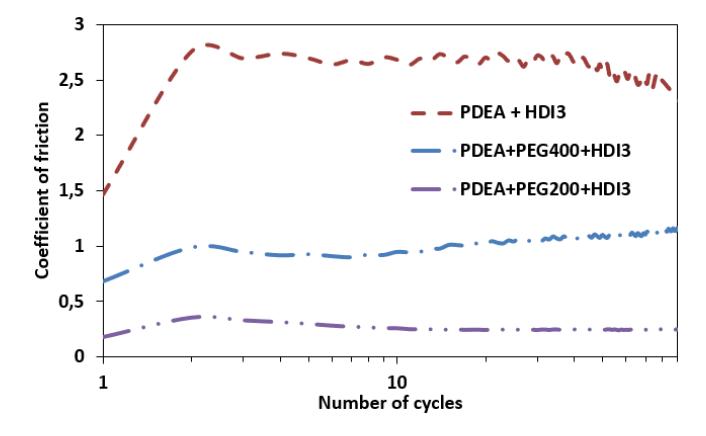
Adding lower molecular weight and short chain polymer PEG not only reduced initial viscosity but also affected final mechanical properties of formed polyurethane. In this case, PEG200 or PEG400 reduced COF at least two times of the formed PUR sheet. More experiments are needed to investigate the effects of different PUR mixtures.