Viscosity is the essential physical characteristic of cell membranes – it controls diffusion of lipids and macromolecules, affects the lipid raft formation, and influences the passive transport of solutes across the plasma membrane. Lipid membranes are inherently heterogeneous and are able to phase separate into liquid ordered (Lo) and liquid-disordered (Ld) domains. Viscous Lo phase is of particular biological importance – ordered microdomains of lipids and proteins, so called lipid rafts, play a key role in immune signaling [1,2], host-pathogen interactions [3,4], cardiovascular diseases [5], and cancer [6-8]. Thus, the ability to distinguish Lo and Ld phases and determine their precise viscosity values is of great interest and viscosity-sensitive probes offer a convenient solution for this task.
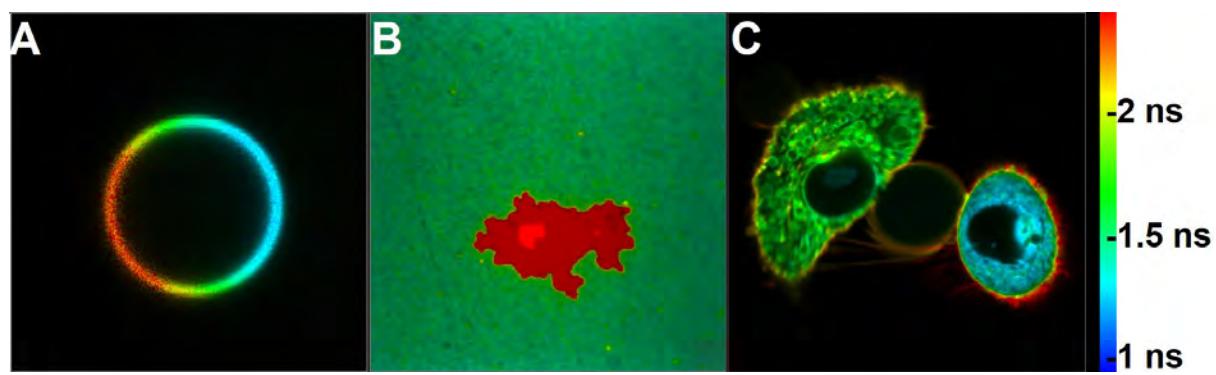
In this work, we present novel membrane-targeting viscosity probe - BODIPY-PM. Combining the use of BODIPY-PM with Fluorescence Lifetime Imaging Microscopy (FLIM), we demonstrate the ability of BODIPY-PM to recognize Lo and Ld phases in complex biological systems - large unilamellar vesicles (LUVs), tethered bilayer membranes (tBLMs) and live cancer cells (Fig. 1). In addition, we explore the plasma membrane viscosity changes in cells that undergo apoptosis. Importantly, our method allows both imaging and dynamic monitoring of viscosity changes in real time in live cells, as well as model lipid systems.
Fig. 1. FLIM images of DOPC/DPPC/Chol LUV showcasing phase separation (A), DOPC/DPPC/Chol tBLM with Lo domain in the center (B), viscosity changes in cancer cells during apoptosis – on the left, and before apoptosis – on the right (C).
[1] K. A. Field, D. Holowka, B. Baird, Fc epsilon RI-mediated recruitment of p53/56lyn to detergent-resistant membrane domains accompanies cellular signaling, Proc. Natl Acad. Sci. USA92, 9201-9205 (1995).
[2] P. Varshney, V. Yadav, N. Saini, Lipid rafts in immune signalling: current progress and future perspective, Immunology149, 13-24 (2016).
[4] E. Teissier, and E. Pecheur, Lipids as modulators of membrane fusion mediated by viral fusion proteins, Eur. Biophys. J.36, 887-899 (2007).
[5] F. J. O. Rios, M. Ferracini, M. Pecenin, M. M. Koga, Y. Wang, D. F. J. Ketelhuth, S. Jancar, Uptake of oxLDL and IL-10 Production by Macrophages Requires PAFR and CD36 Recruitment into the Same Lipid Rafts, PLoS ONE8, e76893 (2013).
[6] J. B. Larsen, M. B. Jensen, V. K. Bhatia, S. L. Pedersen, T. Bjørnholm, L. Iversen, M. Uline, I. Szleifer, K. J. Jensen, N. S. Hatzakis, and D. Stamou, Membrane Curvature and Lipid Composition Synergize To Regulate N-Ras Anchor Recruitment, Nat. Chem. Biol.11, 192-194 (2015).
[7] C. Gajate, and F. Mollinedo, Edelfosine and perifosine induce selective apoptosis in multiple myeloma by recruitment of death receptors and downstream signaling molecules into lipid rafts, Blood109, 711-719 (2007).
[8] Á. Cuesta-Marbán, J. Botet, O. Czyz, L. M. Cacharro et al., Drug uptake, lipid rafts, and vesicle trafficking modulate resistance to an anticancer lysophosphatidylcholine analogue in yeast. Journal of Biological Chemistry, J. Biol. Chem.11, 192-194 (2015).