Europium is the rarest element among the lanthanides and yet the most reactive one. Europium element has two different oxidation states +2 and +3 with the electronic configuration [Xe]4f6 and [Xe]4f7, respectively. It is easier to obtain inorganic materials doped with europium with +3 oxidation state than with the oxidation state +2, which relates to reductive synthesis conditions. Despite the high reactivity of europium element, it has also interesting luminescence properties. The Eu3+ ions emit strong red-orange visible light exciting in the UV range of energy for the electromagnetic spectrum. [1]. Therefore, this ion can be used as a sensitive luminescence probe. Moreover, many studies confirmed the highly biocompatible properties of inorganic composites based on calcium phosphate compounds doped with Eu3+ ions [2].
Synthetic apatites are widely used in biomedical field, as a bone or teeth fillers, due to their highly developed specific surface and ability to develop stable bond with living tissues. Fluorapatites have particular advantage over hydroxyapatites via their structural stability and more resistant for demineralization process that occurs in the bone tissue. Hence, fluorapatites can be more suitable substitution for hydroxyapatite in biomedical uses [3].
Rubidium as a trace element can occur in the low concentration in human teeth. However, it seems to have valuable biological features. Interestingly, many studies confirmed biocompatibility of Rb+ ions and their positive effect on osteo- and chondrogenesis. Moreover, by its similarity to lithium ions it also exhibits antidepressant properties [4].
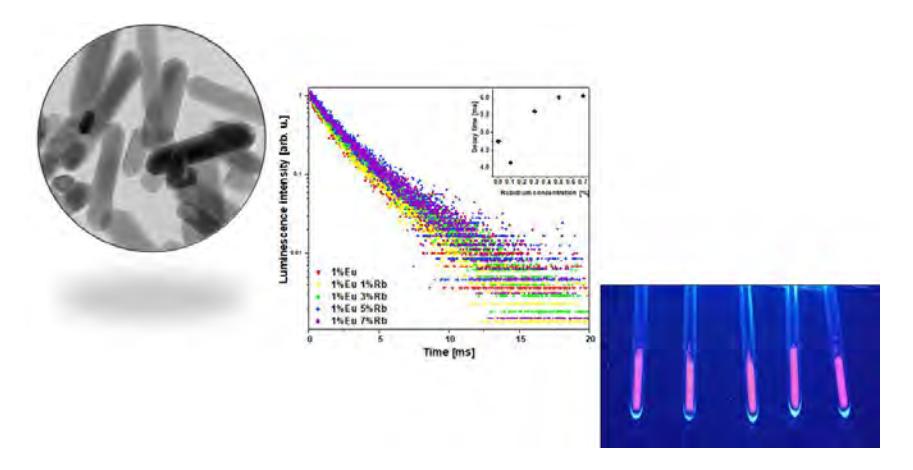
Our research team developed highly stable two series of fluorapatite compounds co-doped with Eu3+ ions and various concentration of Rb+ ions (1, 3, 5, 7 mol%). Structure and morphology were investigated via X-ray powder diffraction technique (XRPD), infrared spectroscopy (FT-IR) and transmission electron microscopy (TEM). Luminescence properties were evaluated by measuring emission and excitation spectra but also by luminescence kinetics. Finally, to evaluate biological properties obtained nanomaterials were tested toward NHDF. Additionally, immune response was evaluated by testing materials toward THP-1 macrophage cell line.