
Macromolecular matrices are a variety of compounds that form cavities capable of complexing small molecules - these large compounds are also called cavitands. Such complexes can be used in a wide range of applications: catalysing difficult reactions, binding proteins for structural analysis, detecting various compounds, increasing the solubility of compounds. Also, molecules complexed in cavitand exhibit different properties than the ones that are not bound in this complex: these molecules can be stabilized in conformations that do not normally occur, and can participate in exotic chemical reactions. One of the molecules that can be complexed is O-(n-octanoyl)-L-serine (Fig. 1. A.), one of the amino acids in the naturally occurring hormone ghrelin. This molecule is thought to insert its aliphatic chain into the cavitand to form a stable complex. We aim to investigate the intermolecular structure of this complex, as well as the conformational equilibrium of O-(n-octanoyl)-L-serine in different media.
Experiment methods have already been carried out to analyse the complex of O-(n-octanoyl)-L-serine with cavitand (Fig. 1. C.), and hypotheses have been put forward on the structure of this complex [1]. In order to better interpret the experimental data that can be obtained while working with these compounds, it is worthwhile to use molecular dynamics simulations (MDS). This method provides information at the molecular level that is unavailable experimentally. MDS in this situation provide a significant amount of structural information in a relatively simple model. MDS were therefore carried out for two systems: one with 3000 water molecules, one molecule of O-(n-octanoyl)-L-serine and one chloride ion, and the other with 4000 water molecules, a complex of O-(n-octanoyl)-L-serine and a cavitand and five chloride ions. Structure of the cavitand and of the O-(n-octanoyl)-L-serine are shown in Figure 1. (Fig. 1. A. and B.).
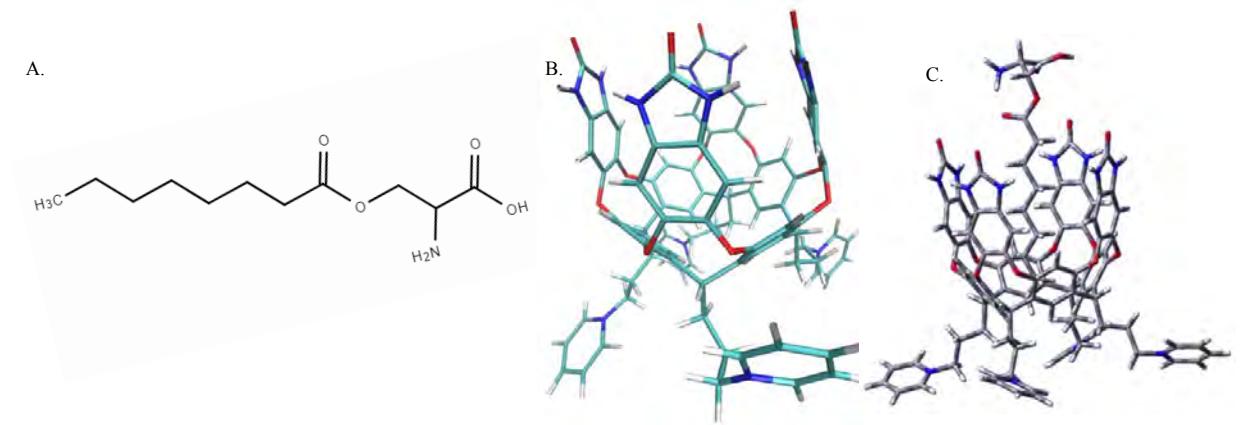
The molecular dynamics simulations under NPT and NVT ensembles were followed by calculation of the radial distribution functionsas well as other structural parameters. From the radial distribution functions, coordination numbers for atoms that can form hydrogen bonds have been calculated and a distinct cavitand steric effect has been observed. It was also found that the conformational changes of the aliphatic chain of the O-(n-octanoyl)-L-serine molecule are slower when it is in complex with a cavitand. Analysis of the distance between the bottom of the hydrophobic pocket of the cavitand and the last methyl of the O-(n-octanoyl)-L-serine molecule aliphatic chain confirmed the stability of the complex.