In order to convert high-energy radiation, such as gamma or X-rays, into visible light, special convertermaterials are needed. Such compounds are usually referred to as scintillators. Over the years many different candidates to fit the requirements were examined. However, compounds with garnet structures have attracted a particularly large amount of attention. Cerium or praseodymium doped lutetium and gadolinium aluminum garnets have high density, high thermal stability, rather efficient luminescence processes, and thus high quantum efficiency which are needed for a good scintillator [1]. However, further optimization and improvement are still required especially w.r.t. a reduced decay time. The duration of the luminescence decay is important because if it is very short then the more signals can be measured within a defined timeframe, resulting in a better resolved and higher quality image, for example in CT devices. One way to improve materials properties is to doping the aforementioned compounds with different elements. As such, by doping we could potentially be able to improve key aforementioned parameters: emission intensity, quantum efficiency and decay times [2,3]. One of these elements is boron. Primarily, it can be used as a flux, and also B3+ ion has a suitable neutron capture cross section and can also help absorb gamma radiation [4]. However, garnets can be doped with larger amounts of other elements. In this case, we replaced some of the aluminium with scandium. Lutetium aluminium scandium garnets and gadolinium aluminium scandium garnets doped with Ce3+ / Pr3+ / B3+ were obtained as a result. These garnets are synthesized and studied for the first time.
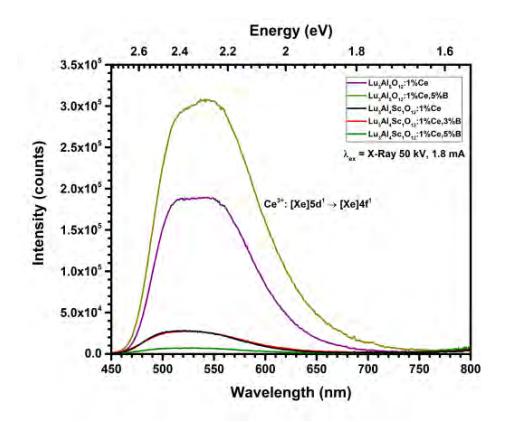
In the present work, the effect of boron and scandium co-doping on the various characteristic of the LuAG and GAG doped by cerium and praseodymium is investigated. Garnets doped with different amounts of boron and scandium were synthesized by the aqueous sol-gel method. The phase purity of the samples was analyzed by means of X-ray diffraction. The morphology of the compounds was evaluated by using scanning electron microscopy. Photoluminescence properties such as emission and excitation spectra, decay curves, quantum efficiency and temperature dependency of the emission and excitation spectra have been investigated. Radioluminescence was also measured in order to determine the scintillation properties of the samples (Fig.1.). The positive impact of boron addition into the garnet structure on the luminescence properties will be discussed in detail.