
Type 1 diabetes mellitus (T1DM), also known as insulin-dependent diabetes, is a metabolic disorder characterized by blood hyperglycemia. In this condition, the pancreas makes little-to-no insulin, therefore, the treatment is directed towards managing the amount of glucose in blood. Chronic hyperglycemia damages, dysfunctions, and causes side effects in a variety of organs and tissues (peripheral nerves, kidneys, eye retina, heart, etc.) [1]. The formation of reactive oxygen species (ROS) and the consequent oxidative stress play a pivotal role in the development of diabetes complications. Increased ROS levels are known to disrupt pancreatic $\beta$-cell mitochondrial function, resulting in decreased insulin release; however, the underlying epigenetic regulatory mechanisms are still poorly understood [2]. MicroRNAs (miRNAs), as one of major regulators of gene expression, play important roles in various cellular processes, including those directly associated with diabetes pathogenesis. Several miRNAs have been identified as potential biomarkers for the assessment of complication risk, however, the currently available data are contradictory [3].
The present study was aimed to evaluate the expression of four selected miRNAs – miR-16-5p, miR-17-5p, miR-106a-5p, miR-223-3p – in leukocyte samples obtained from 40 patients with advanced T1DM and to assess the effect of 4-nitroquinoline 1-oxide (4NQO), mimicking ROS in cells. For comparison, 21 non-diabetic patients (NDP) were also included in the study as a control group. Expression levels of selected miRNAs were quantified by means of real-time PCR using TaqMan-based assays after reverse transcription of all miRNAs.
Expression of the analyzed miRNAs did not differ between T1DM and NDP groups (all p > 0.0500), however, there were some associations with disease complications and clinical-pathological patients' parameters. Notably, after 4NQO treatment, miR-16-5p and miR-106a-5p levels were generally decreased in individuals diagnosed with chronic kidney disease and nephropathy than without a corresponding diagnosis (all p < 0.0500; Fig. 1). In patients with nephropathy, similar associations were also detected for miR-17-5p and miR-223-3p. 4NQO-induced down-regulation of the latter miRNA was confirmed in this patients' group, whereas no effect was observed in the T1DM individuals without the complication. Furthermore, miR-17-5p was differentially expressed between 4NQO-untreated cases with and without nephropathy, whereas only a weak tendency was observed for miR-223-3p in the same comparison (p > 0.0500).
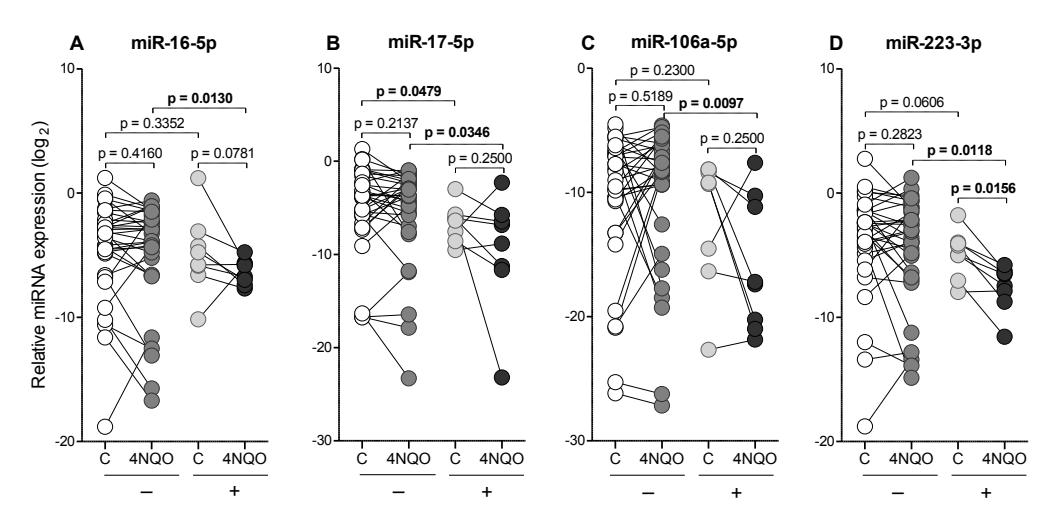
In conclusion, the preliminary data of our study indicate the potential role of the analyzed miRNAs in the development of kidney-related T1DM complications. However, further analysis of larger independent cohorts, followed by functional experiments, would be needed to confirm the findings.