Gadolinium doped ceria (GDC) is one of the most broadly adopted materials for the electrolyte layer in Solid oxide fuel cells (SOFCs) due to its high ionic conductivity [1]. These applications require elaborated surface area which can be achieved over micro structuring the Yttria-stabilized zirconia (YSZ) electrolyte surface via plasma micromachining [2,3], Computer Numerical Control (CNC)[4], or laser-based micromachining [5]. The interaction of ultrashort laser pulses with solid-state materials leads to the formation of various surface microstructures. The ablated crater depth, shape, roughness, and taper depend on the laser processing conditions including intensity, wavelength, repetition rate, scanning speed, etc., as well as the material type irradiated [6].
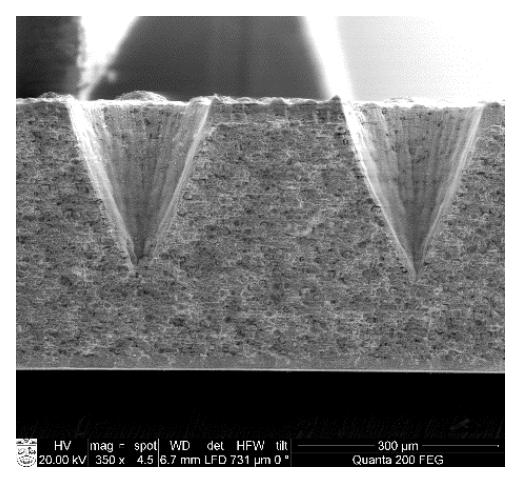
In this work, the impact of 290 fs pulse length Yb:KGW fs-laser Pharos (Light Conversion) processing parameters on the micro-hole morphology in the commercial SOFC cells (400B, Elcogen) was investigated. Firstly, the ablation threshold of the SOFCs was determined by 1030 nm wavelength using 100 kHz repetition frequency. Secondly, three groups of blind microhole arrays were imposed with different laser processing parameters (pulse energy, repeated scanning times, and scanning speed, varied from 3 to 15 μJ, from 2 to 10 times, and 20 to 100 mm/s, respectively). Following ablation, the micro-topography of the blind holes was characterized with a scanning electron microscope (SEM) Quanta 200 FEG (FEI). From the obtained tilted sample SEM micrographs (see Fig.1) it can be noticed that the depth of the micro holes increases with the increasing pulse energy, decreasing the scanning speed, and increasing the number of scanning times.