Recently, bacterial antiviral systems have been shown to cluster side-by-side in bacterial genomes, forming 'defence islands', which lead to an explosion of new discoveries of prokaryotic antiviral systems [1, 2]. One of these new systems is named after the ancient Egyptian deity of protection and fertility, Thoeris. This system consists of two genes, thsA and thsB. The ThsB proteins share homology with the Toll-interleukin receptor (TIR) domains, and in prokaryotic genomes the homologous thsB genes are often located side-by-side in a single operon. Two types of ThsA are found: the first (TH1) consists of SIR2 and SLOG domains, the second (TH2) of transmembrane and Macro domains [2].
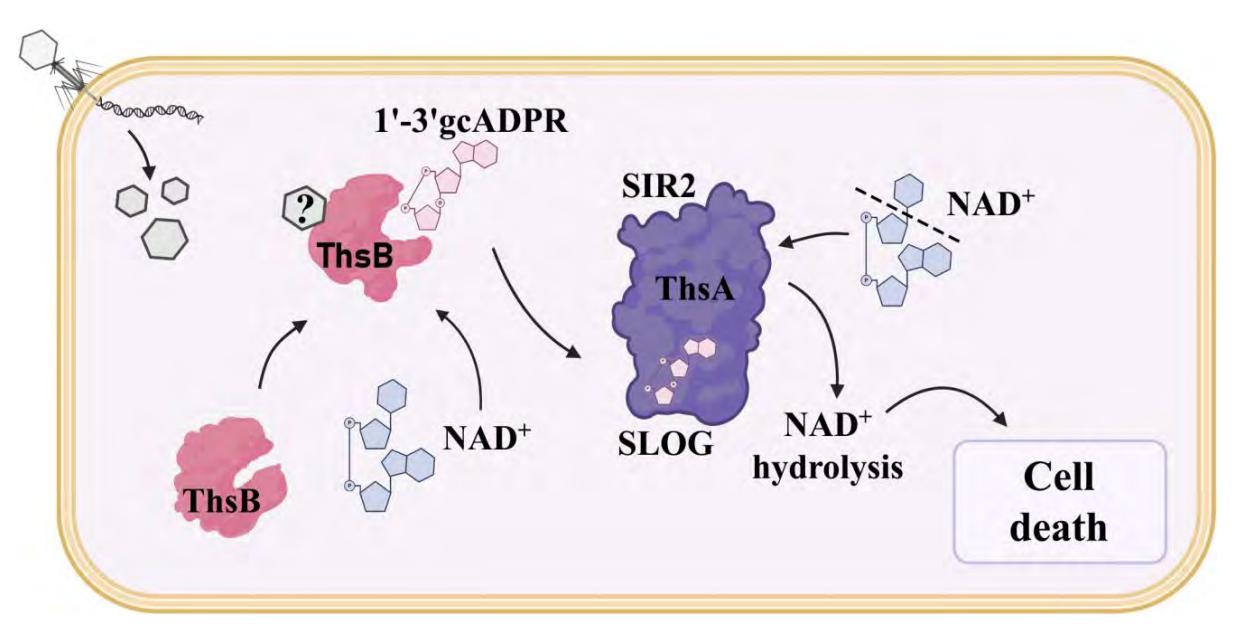
During bacteriophage infection, ThsB proteins of TH1 Thoeris system have been shown to produce the signalling molecule 1'-3'gcADPR from NAD+ [3-5]. These molecules are bound by the SLOG domain of the ThsA protein, which activates the NADase activity of the SIR2 domain when bound. Thus, when the phage infects the bacterium, the Thoeris system consumes all of the cell's NAD+, leading to cell death (Fig. 1.). To date, it is not yet known how ThsB recognises bacteriophage infection and how these proteins are activated to synthesise the signalling molecule [3].
Based on protein sequence ThsBs are classified into 7 phylogenetic clusters. To gain more insight into the function of the ThsB proteins, we decided to determine X-ray structures of ThsBs belonging to 3 different clusters – c2, c3 & c5. For this type of analysis, protein crystals are required, which are obtained by performing crystallization experiments with the purified recombinant protein. Crystal structures of the selected ThsB proteins would provide the basis for further studies on the recognition of bacteriophage infection and the regulation of the enzymatic activity of the ThsB proteins.