
Current research on cancer [1], cardiovascular diseases [2], and other health related issues [3] often employ biosensing technology as a tool for detection of various analytes. Biosensing based on biomarker exhibit low detection limit [3]. However one of the main disadvantages using biomarkers for sensing applications is the emergence of photobleaching, which reduces fluorescence lifetime, and as a result, reduces the signal intensity, making the detection of analytes complicated. Light-matter interaction in strong coupling regime provide a method of minimizing the effects of photobleaching due to the formation of new polaritonic states which alter chemical reaction rates [4]. Theoretical modelling of strong coupling has been performed between molecular excitons induced in labeled antibodies and surface plasmon polaritons (SPP) induced in gold [5].
Investigation of a model consisted of thin gold (45 nm) film and Human Serum Albumin (HSA) layer (11 nm) sand-witched between BK7 glass on one side and water on the other was used. AlexaFlourTM 633 was used as protein dye. Optical response of the model was calculated for different concentrations of labeled antibodies in total internal reflection (TIR) configuration. Dispersions in strong coupling regime show the emergence of Rabi energy gap and the formation of upper and lower polariton branches at the anti-crossing point, where dashed lines indicate dispersions of uncoupled system (Fig. 1a). Analysis of Rabi gap dependence for different concentrations of labeled antibody, demonstrate parabolic relation, indicating the relation between adsorbed protein mass to the gold surface and Rabi energy gap (Fig. 1b).
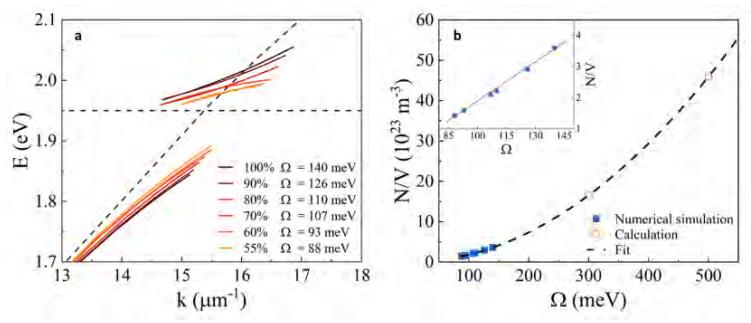
The coupling strength between labeled protein and SPP varies from 88 meV to 140 meV and is dependent on the relative concentration of Alexa633 protein dye. Direct relationship between Rabi gap and number of particles participating in strong coupling can be evaluated from equation [4] which describes proportionality of Rabi energy as a square root of density of states. Number of particles in strong coupling regime is around 1 – 4×10²³ and can be linearly approximated due to minor changes in modelled Rabi energy gap (Fig. 1b (inset)).
It was shown that Rabi gap had parabolic dependence on the number of labeled antibodies attached to the gold surface, however the dependence can be linearly approximated for low number of particles participating. The study presents strong coupling regime as a tool to minimize photobleaching effect and paves the alternative way for detection and monitoring of the protein on the metal surface.