
Conformational analysis is an important part of the study of organic compounds and their properties. This work concerns on the possible conformations of the molecule 1,1-dichlorgermacyclopentane, a recently synthesized molecular compound. The conformers may differ in their physical properties, reactivity, etc., therefore detailed conformational analysis of the molecule is needed to predict its behavior1. The aim of our study is to determine the possible stable conformations 1,1-dichlorgermacyclopentane using vibrational spectroscopy and DFT calculations.
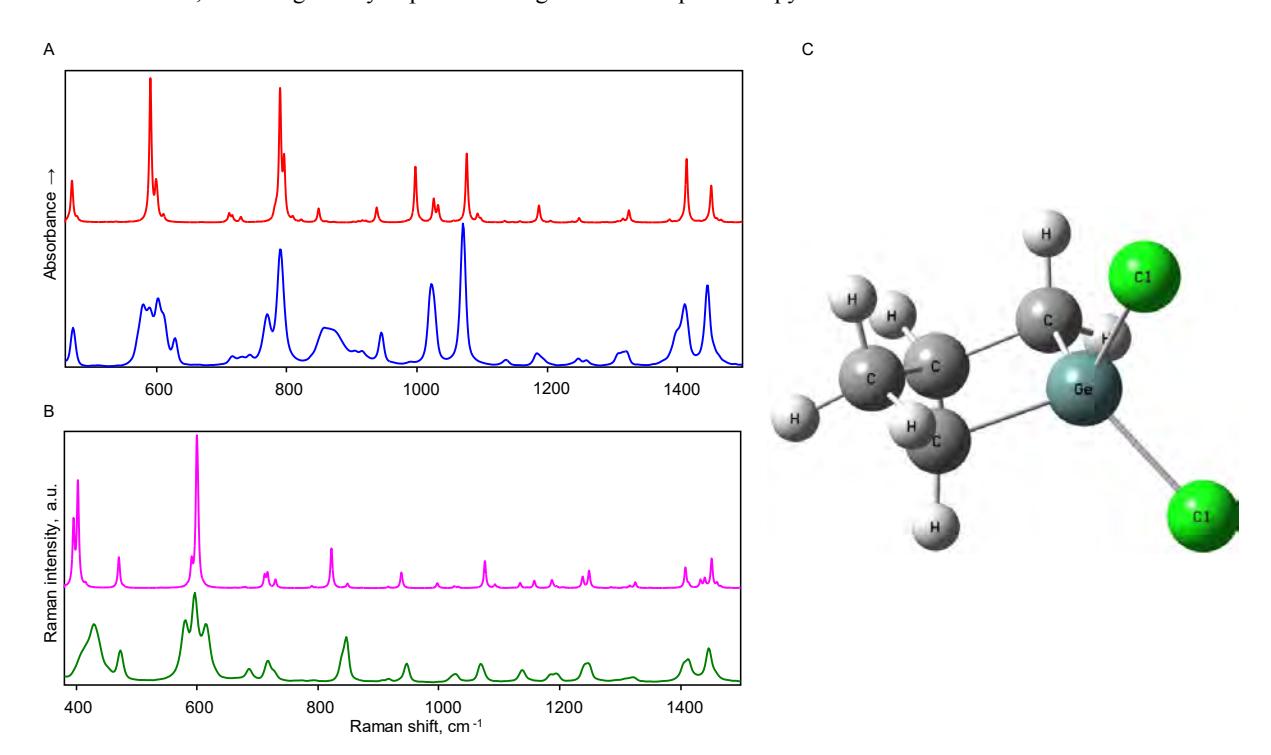
Four different techniques of vibrational spectroscopy were employed to study the molecule. Firstly, liquid phase ATR infrared spectra were recorded in order to get the first view of the vibrational spectra of the molecule. To complement these data Raman spectra were recorded as well. Additionally, experiments with polarized Raman scattering were performed in order to facilitate attribution of experimental bands to symmetric and antisymmetric vibrational modes. Finally, in order to investigate further on possible conformational dynamics, gas phase and matrix isolated molecule infrared spectra were recorded. Interpretation of spectroscopic data was performed with the use of DFT calculations.
DFT calculations were performed utilizing B3LYP functional and augmented Dunning correlation-consistent valence double zeta basis set and assessing anharmonicity. The calculations reveal that 1,1-dichlorgermacyclopentane has one stable conformation (see fig. 1C) - the envelope conformer. The calculated spectra fit well with the experimental ones (see fig. 1A and 1B), confirming that the computed structure is the one is observed in spectroscopic experiments using liquid sample. Complete assignment of experimental spectral bands was performed based on calculation data. Experiments in gas phase as well as the matrix isolation revealed that the molecule is highly unstable in gas phase and defragments rapidly.