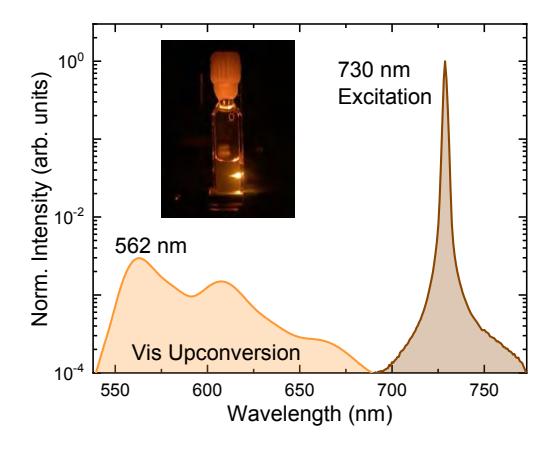
Triplet-triplet annihilation based NIR-to-visible photon upconversion (TTA-UC) is a photophysical process used to generate visible photons from low power density incoherent NIR excitation [1]. Due to forementioned qualities, UC could become handy in various practical applications such as harvesting sub-bandgap photons in photovoltaic devices, using UC materials in night vision equipment, photopolymerization and other fields of science and technology [1-3]. Typically, TTA-UC systems are composed of two types of molecular species: sensitizer and emitter. The first one is used for NIR light absorption and triplet generation, whereas emitter is responsible for triplet-triplet annihilation (TTA) and visible light emission. Rubrene molecule is the most popular emitter option in the field, yet due to aggregation it shows poor performance in solid-state [2]. Modified antradithiophene (TES-ADT) could become a suitable replacement for rubrene and other widely used emitters, due to promising solid-state performance [3] and low triplet state energy. Therefore its photophysical properties in various UC systems should be thoroughly studied.
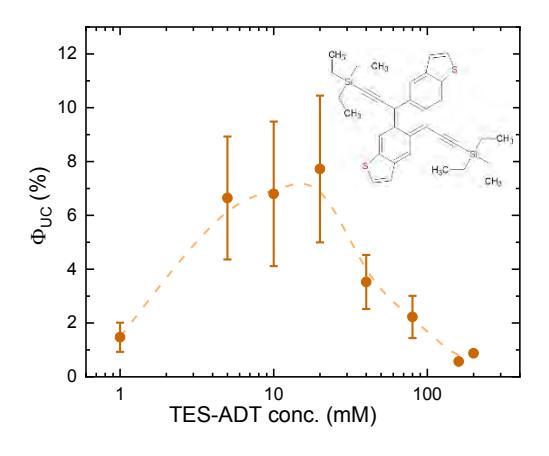
The aim of this research is to investigate liquid TES-ADT based TTA-UC system. To obtain UC the TES-ADT emitter is coupled with palladium phthalocyanine (PdPc) sensitizer. Experimentally, a series of 8 UC samples with constant sensitizer and varying emitter concentration (1 – 200 mM) was made to determine the optimal TES-ADT concentration for the best TTA-UC performance. The performance was evaluated by measuring UC quantum yield (${\Phi_{\text{UC}}}$) using integrating sphere and comparative methods. The results (see Fig. 2) show that 20 mM emitter solution yields the highest value of around ${\Phi_{\text{UC}}}$ = (7,7 ± 2,7)% (Fig. 1-2). Moreover, it is shown that lower emitter concentrations result in poor triplet energy transfer, whereas higher than optimal amount of TES-ADT evoke aggregation indicated by the drop of the fluorescence quantum yield from 100% to 11%. High ${\Phi_{\text{UC}}}$ values obtained, motivate further research and possible applications in solid-state.