
As a result of increasing global warming, renewable energy sources are gaining more interest as an alternative to fossil fuels. One of these alternatives is that the Sun is an infinite resource of energy. Solar cells (SC), also known as photovoltaic devices, are used for the conversion of solar energy into electricity. Nowadays, silicon solar cells (first-generation photovoltaic technology) still dominate the photovoltaic market due to high efficiency and high device stability, despite having disadvantages such as high cost, inflexibility, and opacity, which limit their future development prospects. Fortunately, perovskite solar cells (PSCs) have undoubtedly become the super star in the photovoltaic field, and now the certified power conversion efficiency (PCE) has reached a very high level of 25.7%, which is comparable to that of crystalline silicon solar cells [1].
Holes transporting material (HTM) is one of the main factors of a perovskite solar cell, which determines the cost, energy conversion effectiveness and continuity of the device. However, most HTMs have many disadvantages, including complicated and expensive synthesis, the tendency of self-aggregation, which degrades the quality of the hole transport layer and reduces device stability and efficiency. Therefore, considerable and continuous efforts are made to develop more ideal HTMs, which should exhibit the following advantages: matching well with the valence band and conduction band of the perovskite to enable hole extraction and electron blocking, minimal absorption in the visible and NIR regions of the solar spectrum, sufficient hole mobility, excellent thermal and photochemical stability, high processability, and low cost.
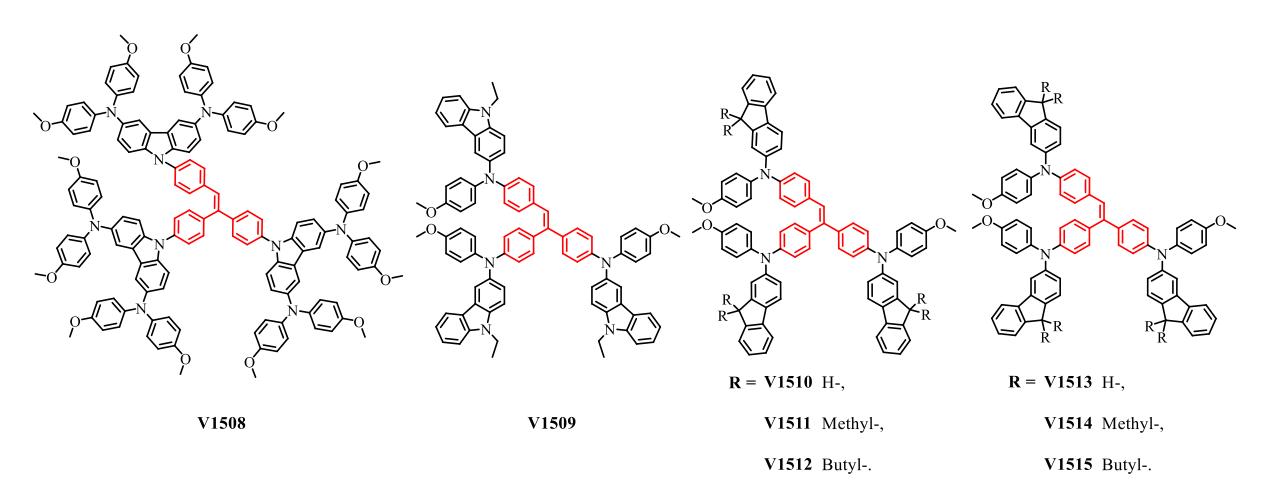
In this work, eight asymmetric 3D HTMs (labeled V1508-V1515) comprising a triphenylethylene core and various side arms were smoothly synthesized. All HTMs were obtained from facile preparation procedures and simple purification techniques. The structures of the synthesized new compounds V1508-V1515 were confirmed by ¹H and 13C NMR, IR spectroscopy, mass spectrometry and elemental analysis data. These compounds are amorphous, which is an advantage for the formation of homogenous films, as well as eliminate the possibility for films to crystallize during operation of the devices. The solid-state ionization potentials (Ip) of HTMs were determined using electron photoemission spectroscopy in air (PESA) of the thin films to assess the HOMO energy levels [2]. Ip values of novel HTMs were found to be lower than 5.7 eV (4,99 – 5,34 eV), which equals to the valence band (VB) energy of the triple cation-based perovskite, therefore efficient hole transfer from perovskite to the cathode should be ensured. Additionally, xerographic time of flight (XTOF) measurements [3] were used to determine the charge mobility of the V-series layers. As a result, the hole mobility of V1508-V1515 was found to be 2.1·10-6 – 4.6·10-5 cm2/Vs at the zero-electric field, which is comparable to that of the reference standard spiro-OMeTAD (4.1·10-5 cm2/Vs) under identical conditions.