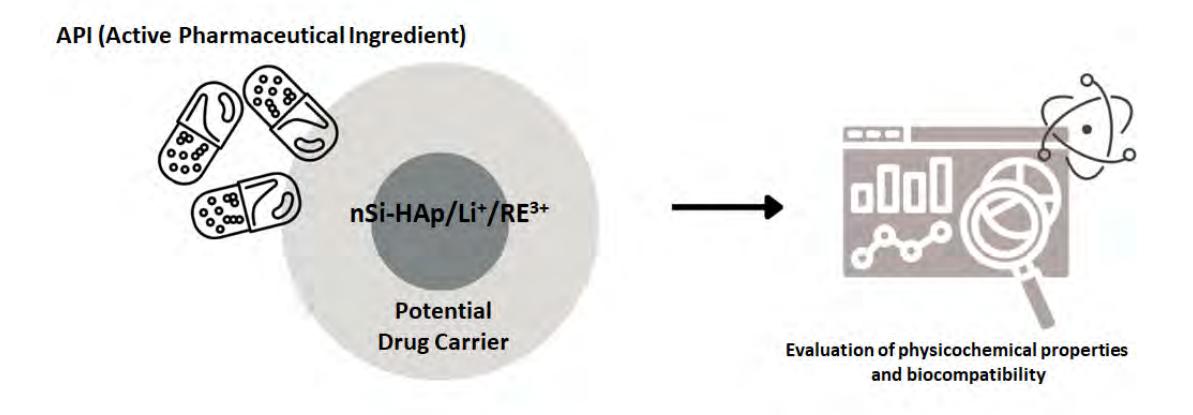
Searching for multifunctional biocompatible materials is of fundamental importance for theragnostic and bioimaging development. Although, hydroxyapatite's (HAp) usefulness in bone repair and tissue medicine is well known, still its potential as a drug delivery agent has been hardly investigated. Mesoporous HAp materials not only have high specific surface areas but also have OH- groups that react with appropriate drug functional groups [1]. Because of that HAp-based materials are suitable carriers for loading and releasing drug molecules. What is more, doping the material with rare earth ions (RE3+) results in highly promising materials applied in disease diagnosis and therapy [2].
Herein, novel silicate-substituted hydroxyapatites (Si-HAp), co-doped with rare earth ions (e.g. Eu3+ and Gd3+ ions ) and alkaline metal ions (e.g. Li+ ion)were obtained via short hydrothermal synthesis. Co-doping with both Eu3+ and Gd3+ ions results in obtaining materials showing simultaneously photoluminescent and magnetic properties. Likewise, the addition of Li+ ion and silicate group (SiO4)4- increases nerve and bone regeneration processes [3,4].
To characterize the physicochemical properties of obtained nSi-HAps, the XRPD (X-ray Powder Diffraction), SEM-EDS (Scanning Electron Microscopy-Energy-Dispersive Spectrometry), TEM (Transmission Electron Microscopy), FT-IR (Fourier Transform Infrared) spectroscopy and ICP-OES (Inductively Coupled Plasma - Optical Emission Spectrometry) techniques were used. In further steps photoluminescence (PL) spectra of obtained materials were studied to determine the optimal dopants concentration for novel drug carriers. The effect of alkaline metal ions on the spectroscopic properties of Eu3+ and Gd3+ ions was thoroughly studied. In the final step, screening in vitro assays were used for the determination of biomaterials cytocompatibility.
In the results new nSi-HAp/Li+/Eu3+,Gd3+ compounds with the hexagonal structure of hydroxyapatite (P63/m group) were synthesized and analyzed. Overall, the presented materials show promising physicochemical properties for potential theranostics applications and are expected to be evaluated in future investigations as potential drug carriers.