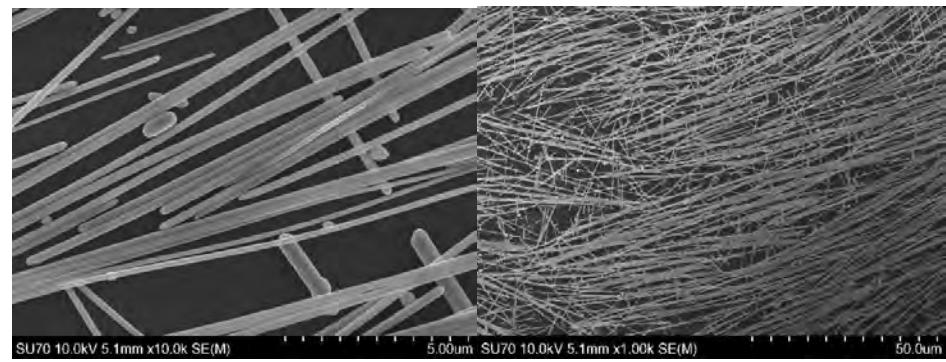
One-dimensional (1D) metal nanoparticles attracted widespread research interest due to their unique electrical, magnetic, optical, thermal, and catalytic properties [1]. Silver nanowires (AgNW) have been one of the main mostly studied NW because of their high electrical conductivity (6.39 S/m) and excellent thermal conductivity (429 W/(m·K)), transparency, physiochemical, optical, and mechanical properties [2,3]. The diameter of Ag nanowires is typically 10-200 nm, and length 5-100 μm [2,4]. AgNW are mainly used in thin-film solar cells, biosensors, organic light-emitting diodes (OLEDs), photoluminescence, surface-enhanced Raman scattering [1,2,5,6].
Among noble metals, Ag nanomaterials are widely studied and used as SERS-active substrate due to their surface plasmon resonance properties. 1D silver NW can provide better insight in investigation the dependence of plasmon-plasmon interaction and electromagnetic scattering due to their panning from nanometer to micrometer scale in length region [7].
Through the years, many synthesis methods were proposed to obtain Ag nanowires. The polyol method to obtain silver NW has gathered much attention since it is facile, scalable, provides good control over nanowire morphology, low production cost [1]. In this work we compare obtained AgNW based on Qian et. al. introduced method. Round-bottom flask with 100 mL of ethylene glycol (EG) containing NaCl, polyvinylpyrrolidone (PVP), AgNO3, and CuCl2 were preheated at 185 °C temperature. Subsequently, 30 mL of freshly prepared AgNO3 in EG was added dropwise with vigorous stirring. After the reaction was completed, the flask cooled down to room temperature. As prepared Ag NWs in EG suspension appeared to be shiny, silky white. The solution in EG was firstly washed repeatedly with water to transfer all the AgNWs/NPs into an aqueous stock solution. Then acetone was added to the stock solution, causing AgNW to precipitate selectively, while the AgNPs remained in the supernatant. After discarding the supernatant and redispersing the pellet in water, the nanowires were significantly enriched and purified [8]. To improve AgNW in length the temperature and heating time was changed. Obtained AgNW were investigated using scanning electron microscopy (SEM), UV-Vis and Raman spectroscopies.