Scientists around the world are constantly looking for new materials that can be applied in advanced photonic application as solid-state lighting or in medicine as theranostic materials. Phosphors based on rare-earth ions (RE3+) are still in the spotlight due to their wide range of applications such as color displays, light-emitting diodes (LEDs), medical diagnostics, solar cells, non-invasive thermometry, and optical heating.
Materials belonging to a large family of apatite defined by the general chemical formula M10(XO4)6Z2 (e.g. M = Ca2+, Sr2+; XO4 = PO43-, SiO44-, VO43-; Z = OH-, F-, Cl-) crystallize in the hexagonal system with the space group P63/m [1-3]. The apatite lattice can be a host for luminescent active ions due to its excellent chemical and thermal stability.
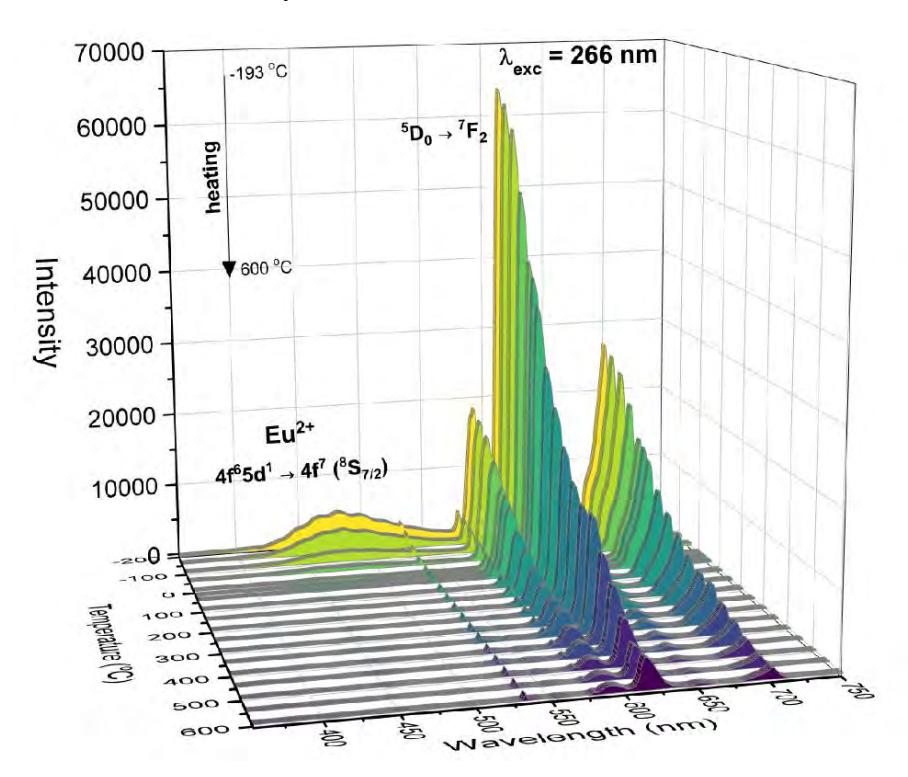
Strontium fluorapatites (Sr10(PO4)6F2) doped with Eu3+ ions were obtained by microwave-hydrothermal method and heat-treated at 600 °C. Their structural and morphological properties were investigated by X-ray powder diffraction (XRD), scanning electron microscopy combined with energy-dispersive spectroscopy (SEM-EDS) as well as Fourier-transform infrared spectroscopy (FT-IR). The luminescence behavior of Eu3+ ions in Sr10(PO4)6F2 nanopowders was studied by using excitation, emission spectra, and luminescence decay time techniques. The electric dipole transition ($^{5}$D$_{0}$ $\rightarrow$ $^{7}$F$_{2}$) is the most intense in all prepared materials. The asymmetry parameter (R) was calculated and discussed. The temperature-dependent emission spectra of the as-prepared as well as annealed 1 mol% Eu3+-doped Sr10(PO4)6F2 were measured in the temperature range from -193 °C to 600 °C and studied extensively.