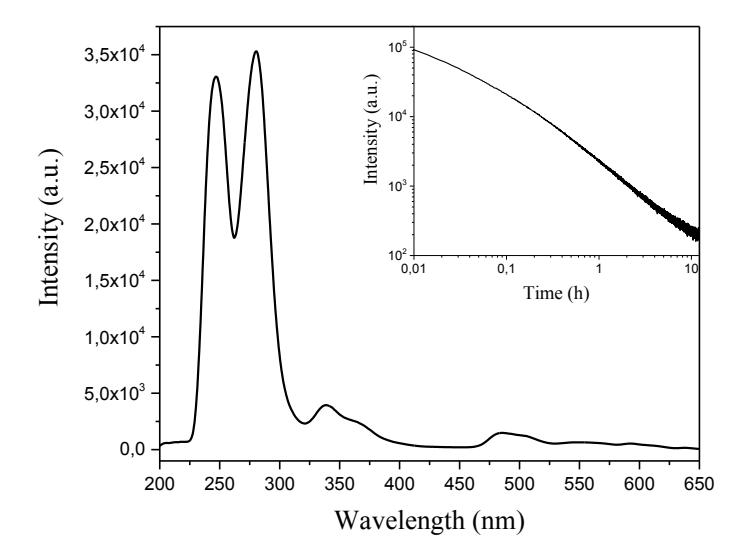
Persistent luminescence (PersL) is a broad field of research and PersL materials are widely used in various applications. In recent years, new PersL materials with emission outside the visible range have been intensively investigated. Some potential applications require emission of high-energy radiation that can be observed in shortwave ultraviolet (UV-C) range, but suitable materials are limited.
In this study, a novel UV-C pesistent phosphor show in Figure 1 – Sr2MgSi2O7:Pr3+ – was developed. The solubility of Pr3+ ions in the matrix was analyzed by X-ray diffraction and the optimal concentration for efficient PersL was determined. Using photoluminescence, thermally stimulated luminescence and electron paramagnetic resonance spectroscopy methods, the optical and structural properties of this material were characterized. By summarizing the obtained results, the knowledge base on the mechanisms of PersL is expanded.