
Organosilicon compounds find a usage in the field of surface science due to its good surface adhesion properties which are mostly related to a $\pi$ electron orbital [1]. The substitution of the carbon atom in the ring with a silicon atom enhances adhesion since it acts as hydrolytically sensitive center that can react with inorganic substrates such as glass to form stable covalent bonds [2]. 1-chloromethyl-1-fluorosilacyclohexane and 1-chloro-1-chloromethylsilacyclohexane were newly synthesized molecular compounds with unknown structural parameters and conformational diversity. In our previous works the detailed conformational, structural and spectroscopic analysis of the latter mentioned molecules is presented. [3, 4] The next step is theoretical studies of the dynamical structural changes and lifetime of different conformers at finite temperature with the help of Car-Parrinello molecular dynamics simulations.
Car-Parrinello molecular dynamics simulations have been performed with PBE functionals, DFT (PW), Nosé–Hoover chain thermostats, temperature was set to 20, 50 and 70 K (to mimic experimental conditions), the production run of 200 ps was derived utilizing the CPMD program package.
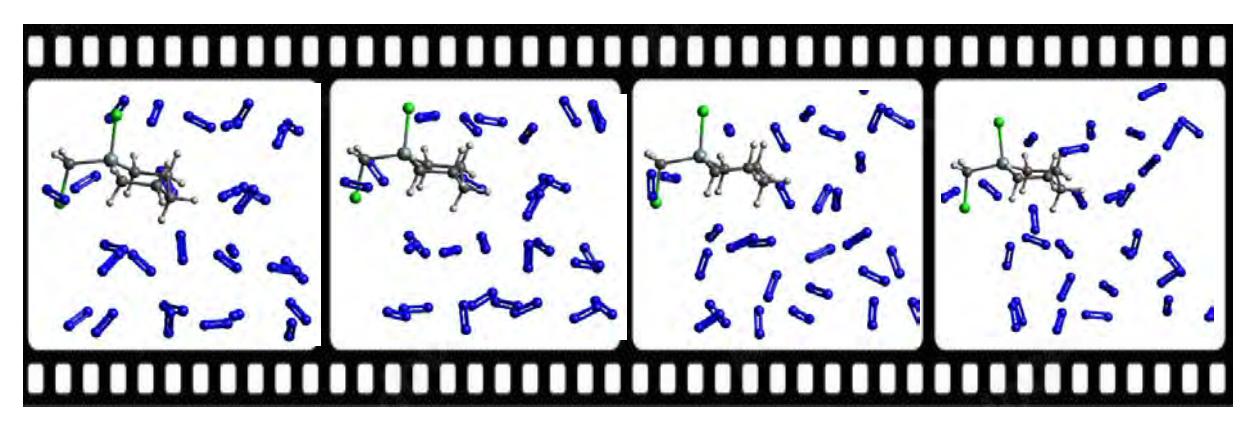
In the matrix the molecule remains in the global energy minimum structure (chair axial trans), the structural parameters and the interaction with the matrix were traced by Radial Pair Distribution Function and bond distance analysis.
The biggest advantage of the Molecular Dynamics Simulations is that they explicitly describe the experimental conditions, due to the temperature influence. The static calculations in most cases, describe the isolated molecules without taking into account the temperature impact. This is a huge step in the computational description of the experimental conditions. Despite the fact the molecule does not undergo any conformational changes, the molecule – matrix interactions were traced.