
CRISPR-Cas are widespread bacterial and archaeal adaptive immune systems, which protect cells against mobile genetic elements, such as viruses or foreign plasmid DNA. The mechanism of CRISPR-Cas systems comprises three stages, called adaptation, CRISPR RNA maturation and interference, while the CRISPR loci contain inverted sequences (CRISPR repeats), interspaced by short fragments acquired from foreign DNA (spacers). A key component in the adaptation step is the heterohexameric integrase complex composed of a Cas2 dimer sandwiched by two Cas1 dimers. The role of this complex is to capture fragments of foreign DNA (prespacers) and integrate them into the CRISPR locus, leading to formation of new spacers that confer immunity against the corresponding viral DNA. So far, CRISPR-Cas adaptation is best described in systems of subtypes I-E and II-A [1], yet the mechanism of spacer acquisition in subtype II-C systems remains unclear.
In order to better understand the adaptation stage of a subtype II-C CRISPR-Cas system, we purified the Cas1-Cas2 integrase complex and determined its structure using cryo-electron microscopy (Fig. 1), which revealed molecular interactions between the integrase complex and prespacer DNA. According to our structural data, Cas2 dimer plays a major role in maintaining non-specific interactions through its ability to coordinate Mg2+ ions, as well as having its α-helices interact with the major grooves of the prespacer DNA. Additionally, the catalytic Cas1 subunits have symmetric Val residues that act as a molecular ruler and ensure the correct prespacer duplex length of 22 bp.
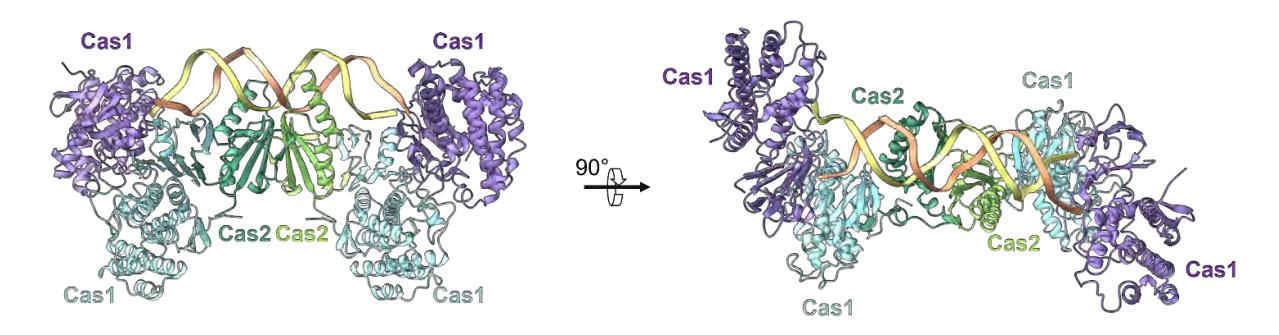
Our results suggest that the adaptation in a subtype II-C CRISPR-Cas system might be generally similar to other type II systems since our obtained structure is comparable to a subtype II-A integrase structure [2]. However, as it lacks accessory proteins like Csn2 and Cas4 found in subtypes II-A and II-B respectively, the overall adaptation mechanism may differ and further investigation is needed to elucidate it.