Homogenous or uniform illumination finds application in many areas of research and industry. In laboratories, it is often used for imaging purposes to illuminate the object. Different industries apply uniform illumination in processes requiring curing by light, such as 3D printing or photolithography. As one of the developing areas, the terahertz band requires development in this direction.
There exists numerous solutions for obtaining homogenous illumination. Some of them require the application of active elements [1]. Other make use of constant input intensity distributions to realize homogenization passively. Such passive structures can be realized in one of three types of systems: refractive [2], reflective [3], and diffractive. Reflective systems tend to be bulky. Refractive, conversely, may result in thick optical elements and thus call for selection of weakly absorbing optical materials. In the terahertz range, such materials tend to be difficult to find. A solution for this is provided by diffractive elements, which produce similar results to the refractive counterparts but are characterized by smaller thickness. This reduction of thickness comes with a cost of reduction to narrowband applications.
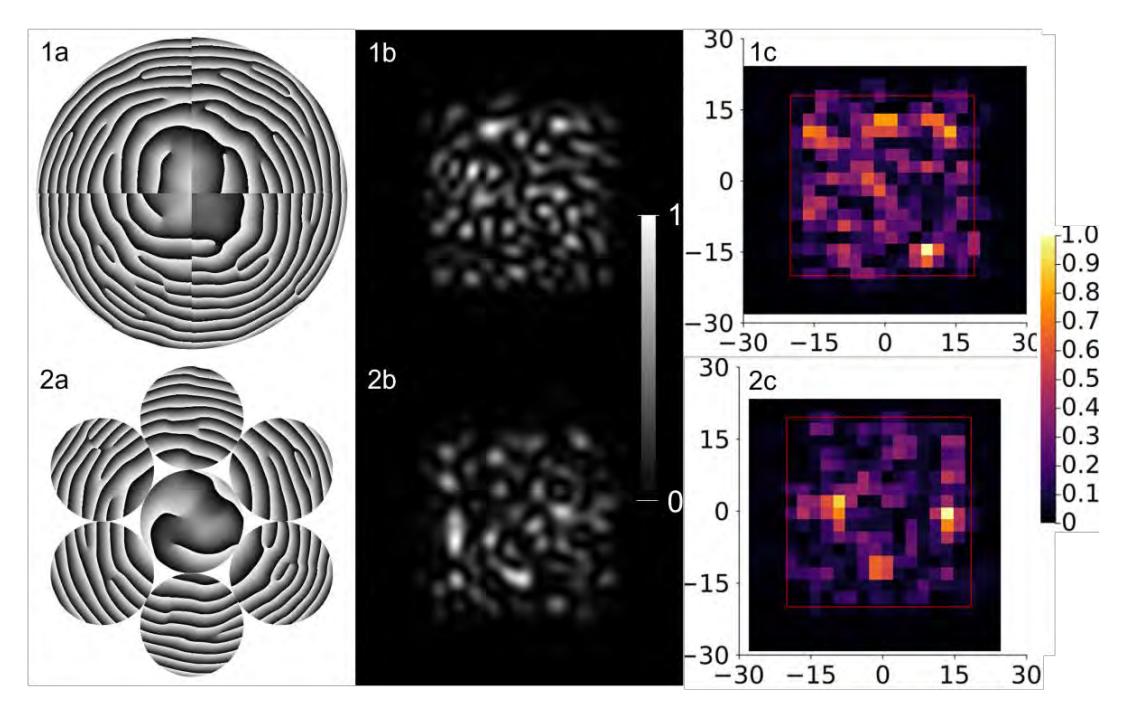
This study explores diffractive and holographic design method to create uniform illumination of terahertz radiation which is realized by division of phase delay map in segments and optimizing the phase modulation of resulting diffractive structure. A number of diffractive structures have been simulated, designed, fabricated, and experimentally verified. Each structure was divided into some number of segments. All segments realized the same functionality: homogenous illumination of a square shape at a defined distance. Segments differed slightly at reconstruction distance. Different structures have been obtained by segment orientations and assembly methods. Examples of two such structures with reconstructions are shown in Fig. 1. The experimental evaluation shows improvement of standard deviation from 0.21 for reference structure to 0.18 and 0.16 for structure 1 and 2, accordingly.