
Effective method for bacteria transformation is using pulsed electric field (PEF), known as electroporation. PEF affects plasma membrane causing pores to form in it thus enhancing cells' permeability to various extracellular substances. While performing electro-transformation exogenous DNA is inserted into a competent cell by means of reversible electroporation – in viable cells foreign genes are inherited upon cell division [1]. Escherichia coli cells, commonly used for electro-transformation, are stored in cold temperatures. However, freezing causes intracellular water crystallization which is lethal [2]. Water crystalisation damage can be minimized by using cryoprotectants, such as glycerol and trehalose.
Mentioned cryoprotectants were used to investigate their impact on E. coli viability after freezing. Different pulsed electric field strength values were tested to find optimal parameters for glycerol and trehalose insertion to prepare competent E. coli cells for further transformation efficiency studies.
Experiments were done with E. coli strain DH5α. Bacteria were grown until 0.5 OD, then centrifuged and resuspended in one of three electroporation solutions: 20% glycerol, 0.1 M trehalose, and MiliQ water was used for control samples. E. coli suspension, held in ice bath during the whole experiment, was electroporated with single electric field pulse with duration of 100 μs and field strength up to 20 kV/cm. Immediately after electroporation cells were transferred to a freezer with -80 °C for a 7 day period. Then cells were defrosted, transferred to a SOC medium and incubated for one hour in 37 °C, serial dilutions and plating were performed after. Cells were plated on agar medium and grown for two days in 30 °C temperature. Counted colony forming units (CFU) were used to evaluate E. coli viability (Fig. 1).
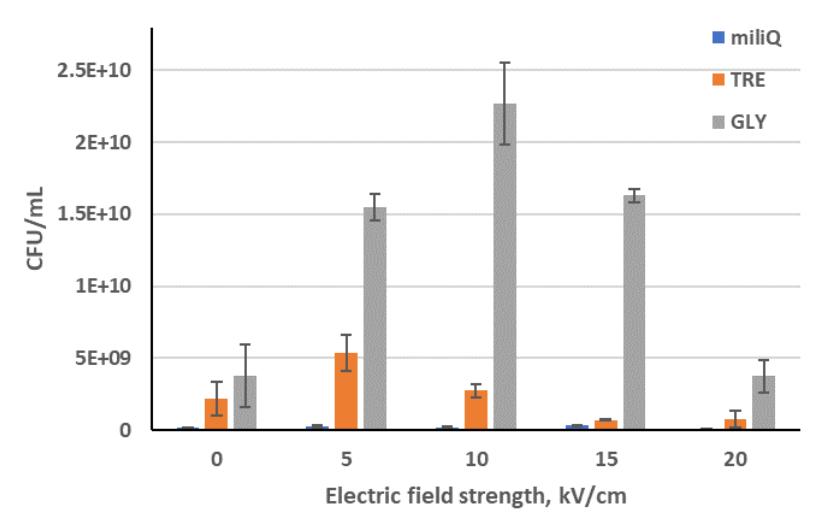
Results revealed that E. coli viability after freezing does depend on both cryoprotective substances inserted into cells and electric field strength application used to insert these cryoprotectants. It was shown that electroporating cells with 5 kV/cm electric field strength before freezing had increased their viability in MiliQ and trehalose solutions, however, bacteria in glycerol solution were affected negatively. For glycerol 10 kV/cm strength was most effective in achieving higher colony unit forming count. E. coli viability has significantly diminished after being treated with stronger electric fields due to electroporation itself causing irreparable damage prior to freezing.
To conclude, cryoprotectants that were inserted into E. coli during electroporation before freezing have a positive impact on cells' viability.