Environmental problems are major worldwide issues. Various companies produce a lot of effluent because of the expansion of the industrial sector, which is characterized by high levels of suspended particles, a high Chemical Oxygen Demand (COD), changing pH, high temperatures, and dye mixtures [1]. TiO2 has been thoroughly investigated as a catalyst to break down dyes and other dangerous substances in wastewater. TiO2 nanoparticles are substances that may be used since they are affordable, eco-friendly, and very sensitive to ultraviolet light. [2] [3]
Grade 2 TiO2 was used for this experiment. It was prepared by cutting it into a circle with a handle, drilling holes, roughening the surface with 220grit sandpaper, and finishing with 800 grit sandpaper. To rinse the surface, tap water and demineralized water were used. Afterwards, it was put into a petri dish for 1 minute with HF, HNO3, and H2O solutions poured on top. After washing with tap and demineralized water, it was placed in an ultrasonic bath for ten minutes before getting rinsed. A mixture of 1L of 5.5g/L NH4F and 132g/L NH4SO4 with demineralized water was electrolyzed for 2 hours at 20V. Then 10mg/l concentration of methylene blue mixed in a 1L flask was degraded using UV light. Ozone was also bubbled into a methylene blue solution with the catalyst.
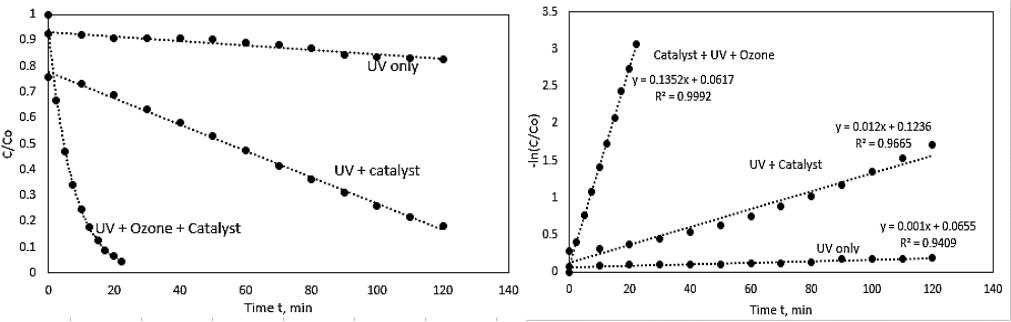
The removal of methylene blue revealed that using UV alone is ineffective, as over 80% of the methylene blue was still present in the solution after 120 minutes. The degradation of methylene blue by UV and catalyst yielded better results, with the concentration after 120 minutes being 1.76mg/l. UV photodegradation with TiO2 catalyst and Ozone yielded the best results in the shortest time frame. After 20 minutes, the methylene blue concentration was 0.472mg/l. According to figure 1, the degradation of methylene blue with the catalyst, UV, and Ozone was 5.4 times faster than with just UV or UV and catalyst. This supports the theory that adding ozone to water treatment improves efficiency and shortens the time required for treatment. The results of this experiment show higher performance than would have been obtained if only pure TiO2 had been used. This improvement is due to increased photocatalytic activity, which has been enhanced by catalyst doping. The reaction constant values show that UV with Ozone and TiO2 catalyst has the quickest degradation.