
According to the Shockley-Queisser theory, photons with energy lower than the forbidden bandgap of a material do not contribute to net photoresponse of a solar cell. Photons with energy higher than the bandgap participate in photoresponse formation [1].
The present work was initiated by the fact that photons with energy smaller than the bandgap can induce photovoltage across a p-n junction, the hot carrier photovoltage, and its polarity is opposite to the classical one [2]. Moreover, calculations show that the 10% share of the total absorbed incident solar light in GaAs belongs to the below bandgap photons, and it strongly depends on carrier concentration and thickness of the layer [3].
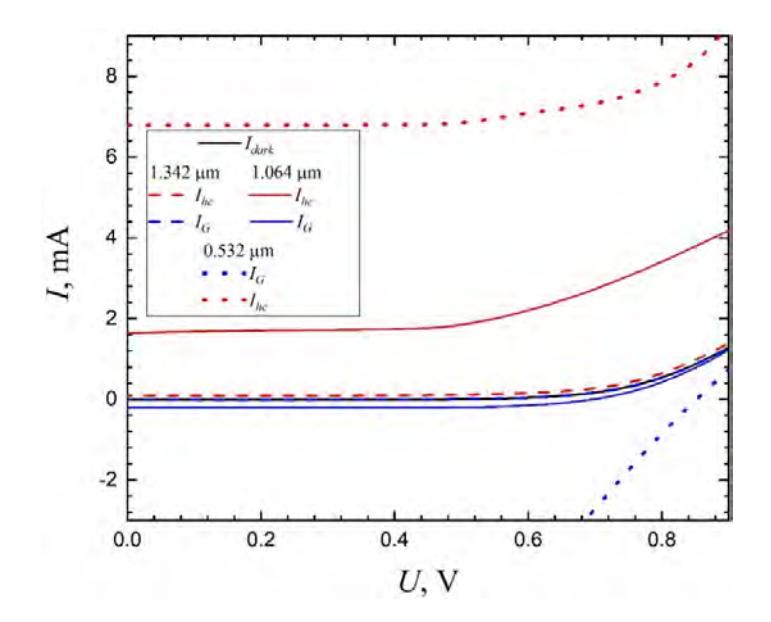
The LPE-grown GaAs p-n diodes (forbidden energy gap is 1.42 eV) were illuminated with pulsed laser irradiation of the same 0.4 MW/cm2 intensity having different wavelengths of 0.532, 1.064 and 1.342 μm. The obtained results reveal several noteworthy points. First, the 1.342 μm-long photons (0.92 eV) mainly contribute to the hot carrier current and do not have enough energy to induce notable classical generation-caused photoresponse. Second, under the action of the 1.064 μm-long (1.16 eV) photons, the hot carrier photoresponse dominates over the classical photocurrent caused by the two-photon absorption since the extra energy left after the excitation of ordinary electron-hole pair, i.e., 0.9 eV, adds to the intraband absorption-caused carrier heating process. Third, even illumination of the diode with laser light of 0.532 μm wavelength (photon energy 2.32 eV is higher than the bandgap) shows, in contrast to the classical theory, that the hot carrier photoresponse is still present and quite marked; most probably it is raised by the excess energy (0.9 eV) left after the classical interband absorption which is much stronger than the two-photon absorption.
It was shown that negative hot carrier effect manifested itself in the p-n junction in both cases, below and above bandgap photons. Thus, the theoretical maximum efficiency of a single junction solar cells (Shockley–Queisser limit) needs revision by taking into account the contribution of the hot carrier phenomenon within the entire solar spectral range.