
Considering recent challenges related to climate change and the state of the environment, as well as increasing progress of sustainable technologies, it is particularly important to develop new sustainable materials applicable in such technologies [1]. Biobased photopolymers well suit for this, as they can be applied in environmentally friendly light-based film, coating, and additive manufacturing technologies.
In this study, cross-linked polymer (VS) was synthesized by photopolymerization of two biobased acrylic monomers: acrylated epoxidized soybean oil and vanillin dimethacrylate, in the presence of the thiol monomer pentaerythritol-tetra(3-mercaptopropionate) [2]. 2,4,6-Trimethylbenzoyl-diphenylphosphine oxide was used as the photoinitiator and 2,5-bis(5-tert-butylbenzoxazol-2-yl) thiophene was used as a UV blocking agent in the photocurable system. Radical photopolymerization and thiol-acrylate photopolymerization were combined in a dual curing system. The photoresin composition was as follows: 3 mol of AESO / 1 mol of VDM / 0.25 mol of PETMP / 2.5 % of TPO / 0.08 % of UV-blocker. The Helios Italquartz lamp (250-450 nm, 310 mW·cm-2) was used for photocuring. The structure of the cross-linked polymer VS was confirmed by FT-IR spectroscopy, Soxhlet extraction, and swelling test. The synthesized polymer VS has a low swelling value of 8-10% in different solvents, mostly due to the high density of cross-links. The yield of the insoluble fraction of the polymer was 95% after Soxhlet extraction with acetone.
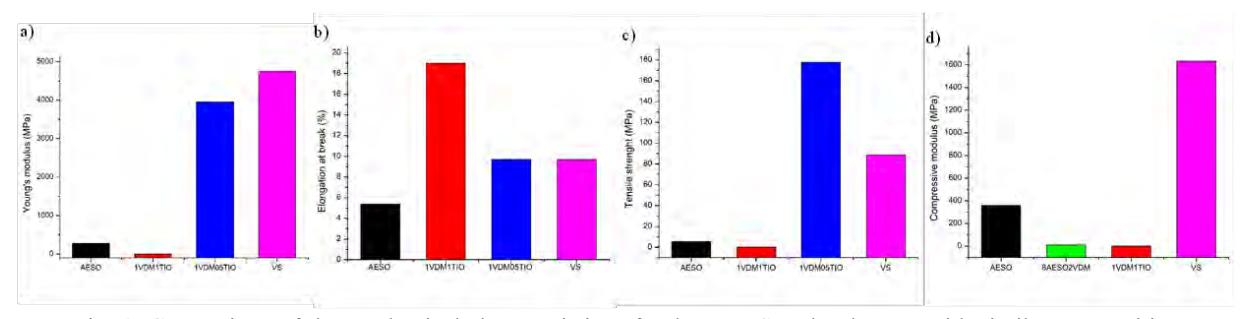
The mechanical properties of the cross-linked polymer were investigated by tensile and compression tests. Young's modulus, elongation at break, tensile strength, and compressive modulus have been determined. The values of these mechanical characteristics were compared with those of other polymers with similar composition. It was found that the cross-linked polymer VS has excellent mechanical properties. It is rigid, strong, non-brittle, and its Young's modulus and compressive modulus are higher than those of other polymers with similar composition, especially the compression modulus (Fig.1).
The thermal properties of the polymer VS were investigated by dynamic mechanical thermal analysis and thermogravimetric analysis. The glass transition temperature of the polymer VS is 9 °C. Such a low value of glass transition temperature is characteristic for cross-linked polymers of vegetable oils, due to the long, flexible fatty acid chains. It was found that the synthesized cross-linked polymer VS has high thermal stability. Its destruction temperature at 10% weight loss is 373 °C and is higher than that of the other polymers with similar structure.