
Lithium-cobalt borate is a candidate for a cathode for lithium-ion batteries, commonly used for electricity storage. This material is distinguished from other polyanionic compounds by its higher operating voltage (4 V) and theoretical power density (860 Wh/kg) [1] as well as greater theoretical gravimetric capacity (215 mAh/g). Electrochemical properties of LiCoBO3 can depend on the method of synthesis and resulting morphology of material.
The main objective of this work was to synthesize lithium-cobalt borate using two methods and to compare the differences in structural properties. The synthesis was carried out using the citrate and modified Pechini methods, belonging to the group of sol-gel methods. Differential thermal analysis was used to determine the temperature ranges for the annealing process. The results of X-ray diffraction measurements provided data on the phases present in the materials and made it possible to define the best calcination conditions. Determination of unit cell parameters and grain size was performed by Rietveld refinement. Scanning electron microscope images were also taken. Raman spectroscopy was used to analyze the chemical bonds in the structure and to check the presence of carbon.
The attempt to obtain pure LiCoBO3 was unsuccessful, although the content of foreign phases such as Co3O4 or CoO in the optimized material is small. The best calcination conditions are 725°C/8 h. Figure 1 shows the XRD data for the best specimens obtained from both methods. It can be seen that the peak positions and intensities of LiCoBO3 phase correspond to those from the reference pattern. Two reflections from Co3O4 in the diffractogram of the sample obtained by the modified Pechini method are marked with stars. A small peak resulting from the presence of CoO in the spectrum of the sample synthesized by the citrate method was distinguished with the heart.
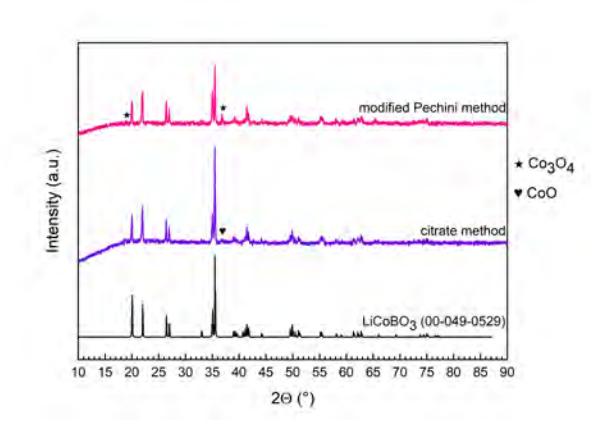
Materials gained from both methods do not contain carbon. This outcome is successful. The resulting gel contained a lot of organic substances which, after thermal decomposition in an argon atmosphere, may have remained in the sample in the form of carbon. An increased relative amount of this element may have a negative effect on the electrochemical properties of the sample. The following cell parameters were determined from the Rietveld refinement: $a = 5.1335(2)$ Å, $b = 8.8431(3)$ Å, $c = 10.1047(2)$ Å, $\beta = 91.377(4)$°, $V = 458.58(2)$ Å3 for the sample synthesized by the citrate method, and $a = 5.1358(2)$ Å, $b = 8.8545(3)$ Å, $c = 10.1131(3)$ Å, $\beta = 91.378(4)$°, $V = 459.76(2)$ Å3 for the material obtained using the modified Pechini method. The specimen obtained by the citrate method had a slightly smaller unit cell and smaller grain size (23 nm) in comparison to that gained from the modified Pechini method (75 nm). As the sample obtained by the citrate method has a smaller grain size, it is likely to have a higher gravimetric capacity.
Further research needs to be conducted to determine the electrochemical properties of those two samples and to prove the influence of morphology and structural properties.