
Poly(2-methacryloyloxyethyl phosphorylcholine) (pMPC) is known as a hydrophilic polymer with unique properties – antifouling effect, penetration across cell plasma, fluid lubrication, etc. [1]. Due to structural and characteristical similarities to phospholipids, zwitterionic block brush copolymers p(MPC-block-PEO19MEMA) have promising potential for biomedical applications. Supposedly, they can be used as lubricants for joint cartilages. The effect of lubrication could be increased if such copolymers possess additional moiety capable of sticking to the surface of cartilages. It is well known that the polymers containing catechol side groups possess surface adhesive properties [2].
In the present study, we developed a strategy to synthesize the copolymers containing copolymeric block p(MPC-co-PEO19MEMA) responsible for lubrication, and the block of poly(dopamine methacrylamide) (pDOPMA) responsible for the attachment of the copolymers to various surfaces. For the synthesis of the copolymers pDOPMA-block-p(MPC-co-PEO19MEMA), acetonide-protected DOPMA (ADOPMA) was polymerized first using 4-(((butylthio)carbonothioyl)thio)-4-cyanopentanoic acid as a RAFT chain transfer agent (CTA), ACVA as an initiator, and DMF as a solvent. pADOPMA was precipitated, purified and dried, giving macroCTA. The second block of p(MPC-co-PEO19MEMA) was synthesized by RAFT copolymerization of MPC and PEO19MEMA at the same conditions and in the presence of the macroCTA pADOPMA. Protective acetonide functional groups of the pADOPMA blocks were removed by trifluoracetic acid. In order to evaluate the effect of PEO19MEMA units on the properties of the copolymers, PEG-free block copolymers pDOPMA-block-pMPC were synthesized as well. The copolymers were studied by size exclusion chromatography, 1H NMR and FT-IR spectroscopy.
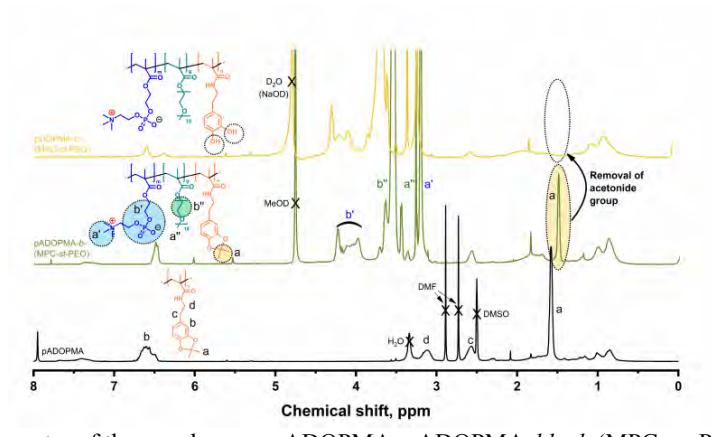
As it was shown in our previous study [3], RAFT copolymerization of MPC and PEO19MEMA leads to the copolymers with strongly expressed gradient microstructure. Thus, the terpolymers pDOPMA-block-p(MPC-co-PEO19MEMA) should possess unique structure combining hydrophilic block with gradient distribution of zwitterionic and brush fragments and relatively hydrophobic block responsible for adhesion. pADOPMA as the first block (DP close to 20) was obtained with rather low dispersity (Đ below 1.2). Unfortunately, we had no possibility to study the copolymers pADOPMA-block-p(MPC-co-PEO19MEMA) by SEC because of the absence of an eluent dissolving both blocks of a very different nature. The only common solvent for both hydrophilic p(MPC-co-PEO19MEMA) block and hydrophobic pADOPMA block was methanol which is not compatible with the known SEC columns. Composition of the copolymers as well as DP of the second block was calculated by studying 1H NMR spectra of the copolymers in MeOD-d6. We succeeded to synthesize diblock brush copolymers in which DP of the second block was from 40 to 80. Moreover, 1H NMR spectra confirmed the complete removal of the acetonide protective groups (Fig. 1).
A study of surface activity and lubrication properties of the synthesized zwitterionic diblock brush copolymers pDOPMA-block-(MPC-co-PEO19MEMA) is in progress.