
Emerging microbiological food safety issues is an increasing problem worldwide. As stated by the United States Food and Drug Administration, there are over 48 million cases of foodborne illness each year [1]. The high resistance of microbes to disinfecting agents has led to the development of alternative antimicrobial technologies. In this context, antimicrobial photodynamic inactivation (API) seems promising. The API principle is based on the combination of a non-toxic photosensitizer (PS) with light irradiation and molecular oxygen [2]. In order to enhance the antimicrobial efficiency of API, the combination of the API with the effects of biologically active agents, such as biodegradable and bactericidal biopolymer chitosan (CHS) is used [3]. The aim of this study was to make a photoactive chlorophyllin-chitosan complex (Chl-CHS) and to investigate the photophysical properties of the complex.
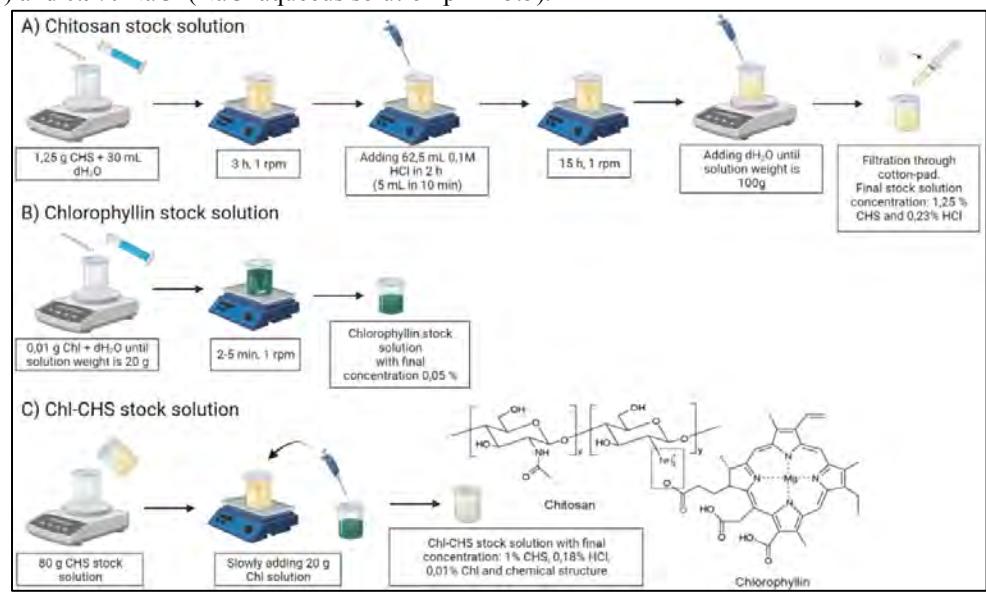
In the first stage of the work, several solutions were prepared: aqueous stock solution of CHS (pH 2.5 at 20 °C) containing 1% of CHS and 0.18% of HCl (Fig. 1A) and stock solution of 0.05% Chl (Fig. 1B). Afterwards, the stock solution of Chl-CHS complex (pH 2.5 at 20 °C) containing 1% of CHS, 1.5 × 10⁻⁵ M Chl and 0.18% of HCl was prepared by drop-wise addition of aqueous 0.05% Chl solution into rapidly spinning aqueous solution containing 1.25% of CHS and 0.23% of HCl (Fig. 1C)[3]. To investigate Chl-CHS aggregates, the complex solution was added to the phosphate-buffered saline buffer (PBS, pH ~ 7.4) and 0.9% NaCl (NaCl aqueous solution pH ~ 5.5).
More different sizes of particles (size from 200 nm to 700 nm) were detected after aggregate measurements in the Chl-CHS complex in PBS at pH 7 than in NaCl (size from 200 nm to 400 nm) when the pH of the solution was only 5.5. It could be explained by the CHS being protonated at acidic pH and more residues becoming available. For further research, more photophysical properties of the Chl-CHS complex should be analysed, such as the dependence of photostability from solution pH and used irradiation dose.