The noble metals gold and silver have gained popularity in nanotechnology due to their broad absorption band in the electromagnetic spectrum and the effect known as localized surface plasmon resonance (LSPR), which determines the optical properties of these metal nanoparticles [1]. They have applications in a wide range of technologies, in the electronics industry, medicine, pharmaceuticals, catalysis, optics, spectroscopy, food industry, etc. [2]. Combining gold and silver into a single material - hybrid nanoparticles - could lead to synergistic effects between the two metals and new technological applications. The generation of clean nanoparticles requires suitable nanoparticle starting materials, which must be completely ligand-free to avoid cross-contamination. Nanoparticles produced by pulsed laser ablation in liquid are well suited to these requirements, this process does not require chemical reagents, stabilizers, or additional ligands and therefore avoids the surface contamination of nanoparticles inherent in chemically prepared analogs [3]. Also it is a confirmed method for the generation of hybrid Au-Ag nanoparticles with a homogeneous distribution of elements on a single-particle scale [4]. However, maintaining nanoparticle stability is a difficulty. A good colloidal solution must be stable. The stability of a colloidal system depends on the interaction forces between formed particles. Particles that are not stabilized can aggregate, thereby hindering their further use.
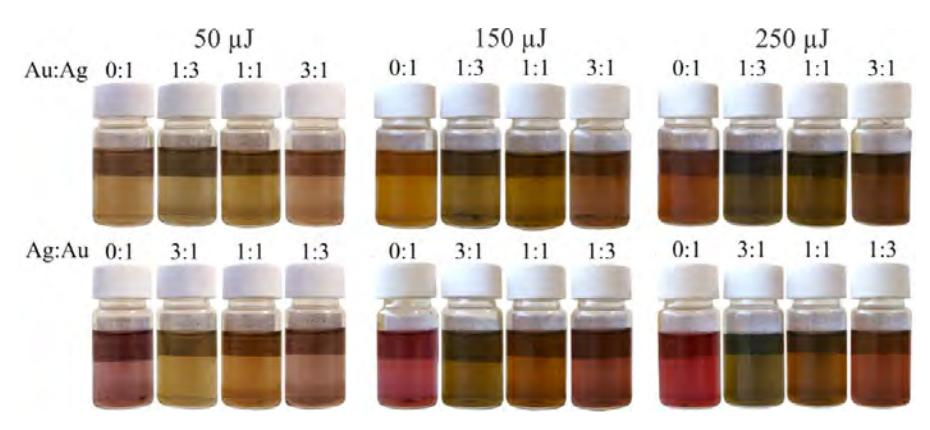
Therefore, this study focused on the stability and how it was affected by the different laser pulse energies (50 μJ to 300 μJ) used. Additionally, thin film evaporation was used to produce hybrid Au-Ag targets (100 nm). Using this method, it was possible to analyze how hybrid nanoparticles are affected when they are made from films with different metal ratios and their order. The nanoparticles were produced in deionized water without the addition of stabilizers. Monometallic and hybrid nanoparticles generated from thin films at laser pulse energies of 50, 150 and 250 μJ are shown in Figure 1. An identical production process was carried out on bulk samples and the characteristics of the colloidal solutions were compared using a spectrophotometer, TEM images, photographs and spectra measurements over a period of 5 weeks. During these weeks, it has become clear that the thin-film approach can produce more stable colloidal solutions, nanoparticles of smaller size and dispersion, and can compare favorably with solutions obtained from a bulk target, as well as what is the most advantageous ratio of metals to form nanoparticles for long-term stability and what pulse energy should be applied.