
Photosynthetic antenna complexes gather solar energy in the form of molecular excitations. Photosynthetic systems based on molecular structures and understanding their functions remains a grand challenge. It is important to study dynamic properties of the excited states of carotenoids and chlorophylls for understanding the mechanism of photosynthesis and it could be done by using molecular dynamics [1,2]. Thus, it is important to study such molecular systems by using molecular dynamics (MD) approaches.
The main challenge in MD is to solve the parametrization problem for Magnesium ion which is located in chlorophyll. Other problems are with preparation PDB files for MD packages. Finally in order to perform computations it isn't trivial task.
For this study it was used AMBER20 (a suite of programs for biomolecular modeling) environment, GaussView tool, WebMO environment, Swiss-Pdb program, the MCPB.py (Metal Center Parameter Builder) script was used for Mg parameterization, visualization with the VMD (Visual Molecular Dynamics) environment. Parametrization was done for geometrically optimized structures with DFT methodologies: B3LYP/cc-pVDZ and CAM-B3LYP/cc-pVDZ. The structures were taken from PDB (Protein Data Bank) database with ID 6A2W [3].
The two selected pigments - carotenoid and chlorophyll - were geometrically optimized using the GaussView tool, then parameterization of the newly created PDB files was performed in the AMBER environment, and separate attention was paid to the parameterization of the metal ion in the AMBER environment. With the help of the Swiss-Pdb program, PDB files were extracted from the calculated optimized value files, which correspond to the PDB format files accepted in the AMBER environment. Pigments parametrization, energy minimization and molecular dynamics were performed for both carotenoid and chlorophyll using the AMBER package environment. In the case of chlorophyll, the MCPB.py (Metal Center Parameter Builder) script was used for Mg2+ parameterization. From the molecular dynamics file of chlorophyll visualized in the VMD environment (Fig. 1), it can be seen that in the AMBER environment, using the MCPB.py method, the molecular dynamics works, but the Mg ion is completely separated from the rest of the atoms.
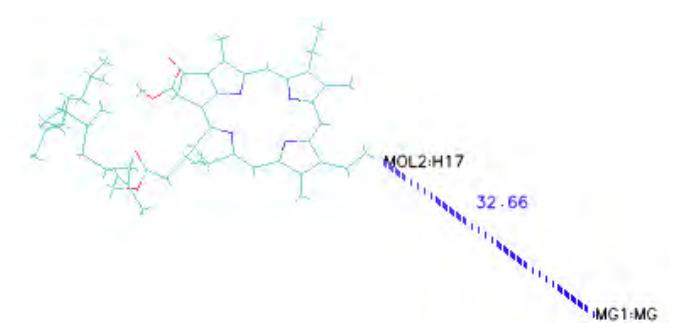
The AMBER environment only accepts PDB files of a specific format, so you need to know all AMBER requirements for PDB files to properly parameterize molecules. The AMBER environment is not designed to handle metal ions directly, so all molecules containing metal ions must be divided into separate files, parameterized separately in appropriate ways, and finally combined to perform minimization and molecular dynamics. Visualizing these files shows that in MD calculations the metal ion is separated from the chlorophyll molecule and does not come back, it is concluded that although successful managed to run MD. The main result that the AMBER MD successfully performs pure computations, but selected parametrization parameters are not accurate enough as final MD molecular structures are not valid.