
Metallic nanostructures arranged in a periodic manner (grating arrays) have recently been used to reduce the losses in metal. Compared with the surface plasmon resonances or local surface plasmons in the randomly distributed metal nanoparticles, the metal nanoparticle lattices have a narrower plasmonic resonance [1]. Such periodic structures based nanophotonic – plasmonic devices have drawn attention to them due to various potential uses, such as plasmonic lasing [2] or enhanced bio-sensing [3], that may sustain prolonged coherence characteristics under the strong coupling. In this research two photonic-plasmonic structures (Fig. 1) that consist of 1D PC and either a thin gold layer (Fig. 1 b) or lattice of gold nano-bump (Fig. 1 c), supporting SPP and TPP modes, were investigated and compared. The strong coupling between the TPP and SPP were measured using the total internal reflection ellipsometry (TIRE) method.
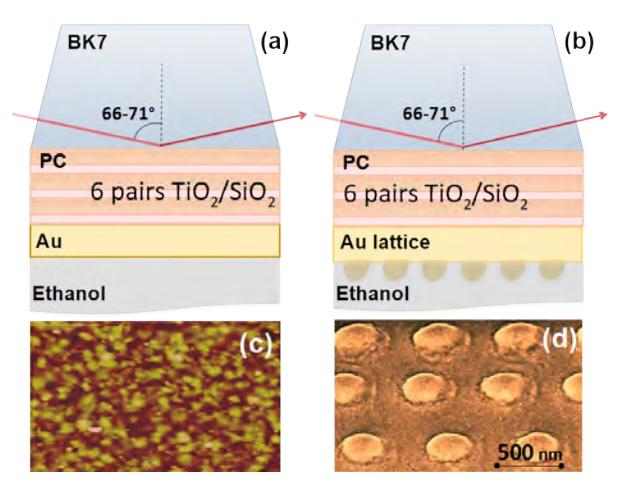
According to recent research, the lattice of gold nano-bumps caused the development of an extra Bragg mode associated to the lattice period that was not strongly coupled to the hybrid TPP-SPP polaritonic mode. Despite this, the surface lattice-induced disturbance of the TPP and SPP components propagation length was discovered. Detailed study revealed that while the propagation length of the TPP reduced as a result of the emergence of an extra Bragg mode, the SPP's propagation length increased. The characteristics of 1D PC's optical dispersion and propagation with uniform gold layer and lattice of gold nano-bumps were evaluated by using a two linked oscillator's model and comparing broadening of the wave-vector vs. energy, allowing to indicate the degree of plasmonic modes field localization. The assessed propagation lengths for SPP and TPP components in hybrid polaritonic mode for nanostructures with homogeneous gold layers were $\delta_{SPP}$=5.5–6.5 μm and $\delta_{TPP}$=6.5–9.5 μm, respectively. In the meantime, the periodic gold surface lattice changes cause the propagation length of the SPP component (SPPlattice) to increase $\delta_{SPP_{lattice}}\approx$7-10.5 μm while the length of the TPP component (TPPlattice) decreases $\delta_{TPP_{lattice}}\sim$5.5-8.5 μm. The application of surface lattice resonances together with strong coupling regime leads to decreasing losses, resulting in the increasing propagation length and better coherence properties of such plasmonic resonances, which in turn promises advanced properties for threshold less plasmonic based coherent emission nano-sources [4].