
Cavitands are container-shaped molecules that are a big part of supramolecular chemistry and are a point of interest particularly for their host-guest interactions. The formations of these host-guest complexes are determined by non-covalent interactions and thus bear a resemblance to biological structures such as enzymes where the binding sites utilize said interactions to confine and orient molecules for reactions that are unfeasible in standart conditions [1]. Such is also the case with cavitands – the container like structures allow for the orientation of reagents, the host molecule can separate the guest molecule from the surrounding solvent, for example, resorcinarene cavitands form capsule-like dimer structures and the resulting capsule itself acts as a solvent thus influencing the solubility of the reagent [2][3].These interactions make cavitands relevant in drug delivery systems, chemical synthesis, etc.
The cavitand introduced by de Mendoza is a cup shaped molecule that contains four 2-benzimidazolone (cyclic carbamide) bridges that enable the cavitand to form dimers via hydrogen bonding [4]. The base of the "cup" is composed of four benzene rings, connected together by alkane bridges, which (in the work by Zhang et. al.) have pyridine "feet" attached to them [5]. This particular cavitand containing pyridine feet demonstrates good solubility in water making it useful for manipulating hydrophobic compounds in water solutions. Furthermore, NMR spectra done by Zhang et. al., indicate that alkanes take up a bent "U" or "J" conformation. Also, the cavitand has been shown to form complexes with drugs and bind to ghrelin.
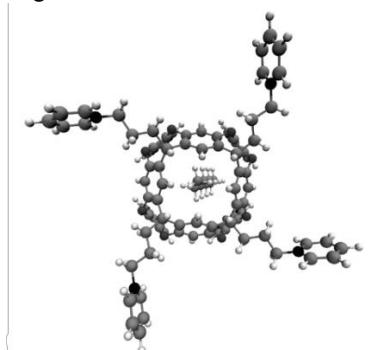
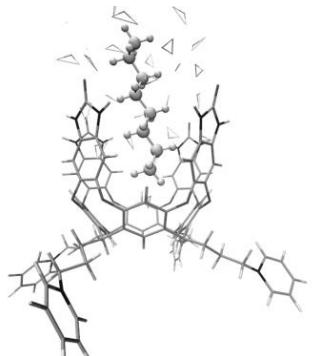
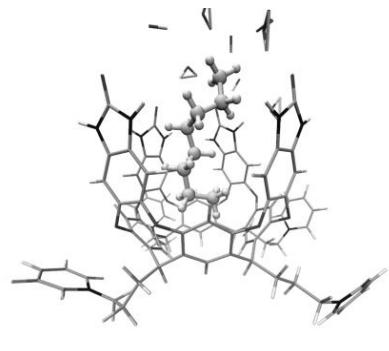
In this work, classical MD simulations of the octane molecule confined within the supramolecular cavitand were performed aiming to evaluate the intermolecular structure of the complex in aqueous solution. The initial geometry of the cavitand monomer was created and optimized using Gaussian, utilizing the $HF/6-31+G^*$ basis set and achieving C4v symmetry followed by analogous construction of the octane molecule, creating a host-guest complex where the guest is a straight n-octane (Cs symmetry) (Fig. 1 & 2). The complex was placed in a periodic box of water molecules and the subsequent steps of energy minimization and equilibration were achieved using AMBER. The equilibration was done under constant pressure, raising the temperature to 298K, achieving standart conditions. The equilibration steps as well as a longer simulation has demonstrated the ability of the host to separate the water molecules from the hydrophobic guest and allow slight conformational changes (Fig. 3). Our MD simulations show the formation of a stable complex between the octane and cavitand molecules. A linear all-trans conformation of octane was observed in the cavitand complex.