In 2020, the global pandemic of COVID-19 was caused by a highly contagious and occasionally fatal severe acute respiratory syndrome coronavirus 2 (SARS-CoV-2). The virus regularly causes mild upper respiratory tract illness, sometimes leading to life-threatening conditions. The search for chemical substances that would act as antiviral drugs against SARS-CoV-2 has been of great importance.
The assembly of mature SARS-CoV-2 viral particles is mediated by main or 3-chymotrypsin like protease (Mpro or 3CLpro). It is one of the 29 proteins encoded in the SARS-CoV-2 genome, responsible for the cleavage of polyproteins in 11 conserved sites. 3CLpro is intensively explored as a potential drug target for the inhibition of viral replication1. Both synthetic compounds and natural substances are investigated as possible antiviral drug candidates using in silico-based, in vitro and in vivo approaches2.
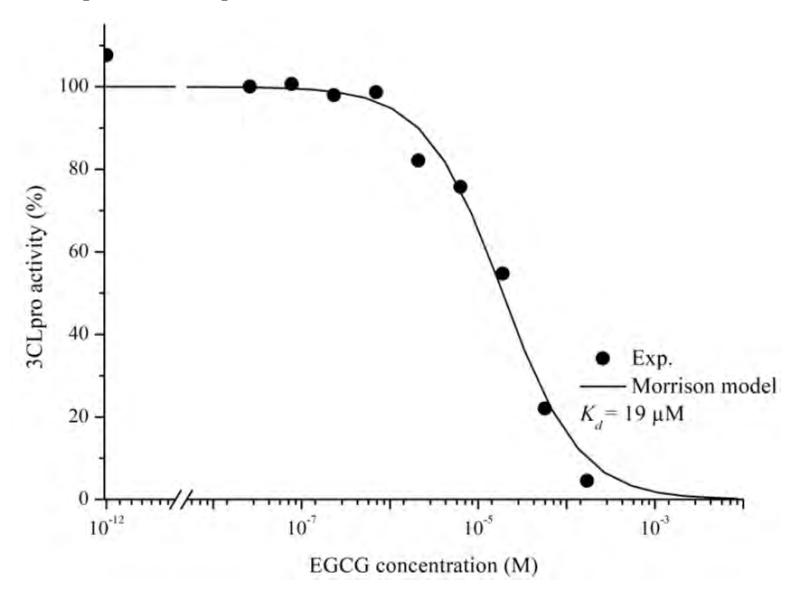
To obtain 3CLpro proteins, two recombinant plasmids were designed and expressed in E. coli. The proteins were purified by affinity chromatography and their catalytic efficiency was determined using in vitro enzyme inhibition assay and later compared with commercially available wild-type 3CLpro. 3CLpro showing the greatest activity was chosen to determine the thermal properties of the protein and screen more than 250 flavonoids as potential 3CLpro inhibitors using fluorescent thermal shift assay. The compounds that stabilized or destabilized the protein were further investigated using FRET-based enzymatic assay. Consequently, several flavonoids were identified as inhibitory compounds and their Kd values were determined by dose-response analysis (Fig. 1), suggesting that naturally derived compounds could be considered potential 3CLpro inhibitors.