
In recent years, solid oxide fuel cells (SOFCs) have played an important role in green energy generation. This technology features low maintenance, high impurity tolerance, wide fuel flexibility, and low pollutant emission, which has proven to be the most efficient and environmentally friendly. An electrolyte is considered as a core component in SOFCs because it determines the fuel cell's operating temperature. Also, there are some requirements that SOFC electrolytes should meet: chemical and physical stability under oxidizing and reducing atmospheres and compatibility with other cell components, high oxygen-ion conductivity and negligible electronic conductivity, similar thermal expansion to avoid cracking during the cell operation, dense ceramic to prevent gas mixing and other [1, 2]. These days, many electrolytes are known such as perovskites (e.g., doped LaGaO3), fluorite structured oxides (e.g., CeO2), and yttria-stabilized zirconia (YSZ), which is commonly used in SOFCs as an electrolyte material. However, YSZ operates at a high temperature (1000 °C), which shortens the lifetime of the fuel cell [3].
LAMOX-type conductors have tremendous potential to become solid electrolytes in SOFC and can operate in intermediate temperatures. At room temperature, lanthanum molybdate exists in low-symmetry monoclinic α-phase, which, above 580 °C of temperature, turns into cubic β-phase and this transition effect increases an oxygen-ion conductivity almost by two orders of magnitude. To stabilize cubic β-phase, lanthanum, and molybdenum sites could be substituted by different cations such as K+, Ba2+, Bi3+, V5+, S6+, W6+. Lanthanum substitution by alkaline earth metals not only could reduce a phase transition, but also could increase oxygen vacancies that lead to higher anionic conductivity of the corresponding ceramic mixture [4, 5].
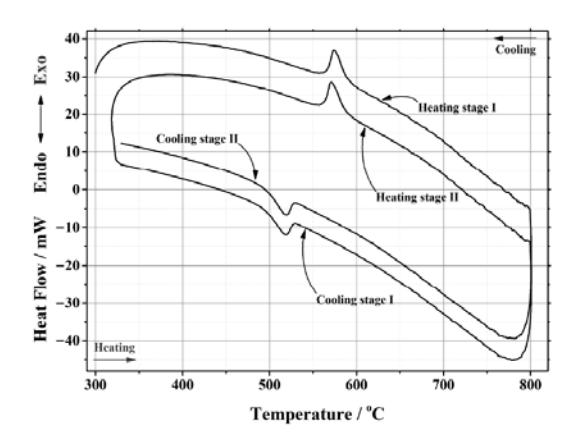
In this work, the La2–xCaxMo2O9–δ (x=0.001–0.3) ceramic was prepared by an aqueous sol-gel synthesis method using tartaric acid as a complexing agent. The phase transition dependency from the substitution degree by calcium in La2–xCaxMo2O9–δ ceramic was investigated by differential scanning calorimetry (DSC). The obtained results showed that the substitution effect reduces the phase transition from cubic β-phase to monoclinic α-phase and vice versa. Furthermore, the influence of sample annealing temperature and sample preparation method on the phase transition are discussed. X-ray diffraction (XRD) analysis was performed to determine the crystal structure and impurity phases of the heat-treated ceramic materials. It was found that homogenous substitution of lanthanum by calcium ions takes place up to x=0.05. Moreover, to analyze the density and surface morphology of the synthesized ceramics heat-treated at 1200 °C, scanning electron microscopy (SEM) analysis was performed.