There is a plethora of piezoelectric ceramics' applications in electronics, telecommunications and medicine. Ceramics containing lead were the most widely used, as they seemed to have the best ferroelectric properties [1]. The problem with lead containing materials is that lead is toxic, which causes the search for lead-free ceramics. One of the most promising lead-free piezoelectric materials is Na0,5Bi0,5TiO3 (NBT). Pure NBT ceramics with their ferroelectric properties hardly reach lead-based materials and are therefore doped with other materials. In this work - cadmium titanate (CdTiO3).
Materials under test with different concentrations of CdTiO3 were prepared by solid state reaction from chemical-grade oxides [2]. We examined samples containing 10 %, 20 %, 35 %, 40 % and 45 % of CdTiO3. Dielectric properties were obtained by cooling samples in a temperature range from 500 K to 100 K with a HP4284A LCR meter. A temperature change rate was approximately 1 K/min. Polarization hysteresis and electromechanical properties were measured with AixaCCT TF 2000 analyzer applying 4 kV external field. Samples were cooled down to 200 K.
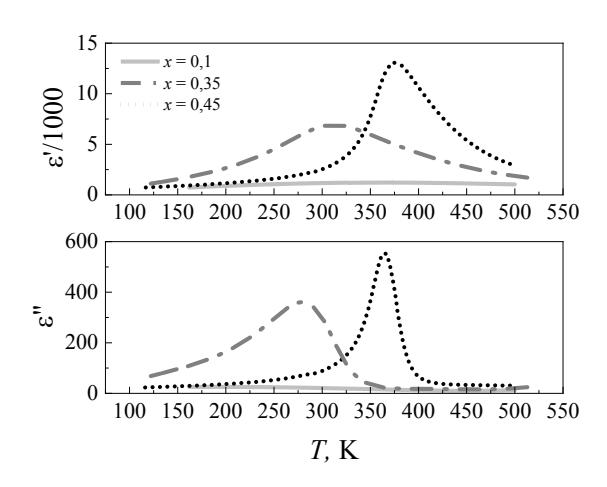
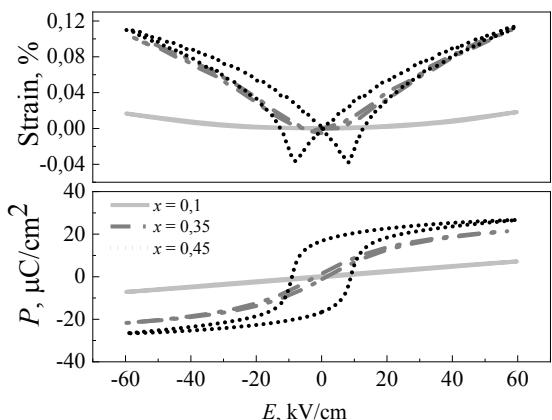
Temperature dependences of dielectric permittivity (Fig. 1) shows that increasing CdTiO3 concentration gives higher dielectric constant values. Comparing it to pure NBT ceramics maximum of dielectric permittivity can be obtained at lower temperatures. Typical ferroelectric properties are only observed for a composition x = 0.45 (Fig. 2). Same results can be seen for sample where x is equal to 0.35 but only at lower temperatures. Behavior of sample with 10% of CdTiO3 is very similar to linear dielectric and stays the same over the whole temperature range.