
The stable isotope ratio method is considered as a "golden standard" in modern [1] and archaeological [2] dietary studies. In general, carbon isotopic ratios reveal food sources and nitrogen – trophic levels with isotopic enrichment at each trophic level. Thus, in stable isotope ecology, "you are what you eat plus a few ‰" [3].
In this work, stable isotopes were applied in the fields of ecology, archaeology, and forensics. Modern human hair samples were analyzed to show dietary differences in people according to their diets (vegetarians, eating meat or fish). The modern human hair study revealed that ${\delta}^{15}$N values of those who eat fish and meat are higher (> 10 ‰) and the known keratin-collagen fractionation factor allows the use of these results to compare with archaeological data, where only bone tissue usually survive. Therefore, modern studies can help to better understand the dietary practices in the past.
In a further archaeological study, preserved human from various regions and historical periods bone collagen and bioapatite samples were analyzed to find out more about dietary practices in the past. Stable isotope data showed that humans during the I-II millennium in Lithuania relied on C3 photosynthetic plants and terrestrial animal food sources. There were significant differences between humans from different regions (urban, rural, and coastal) (Fig. 1).
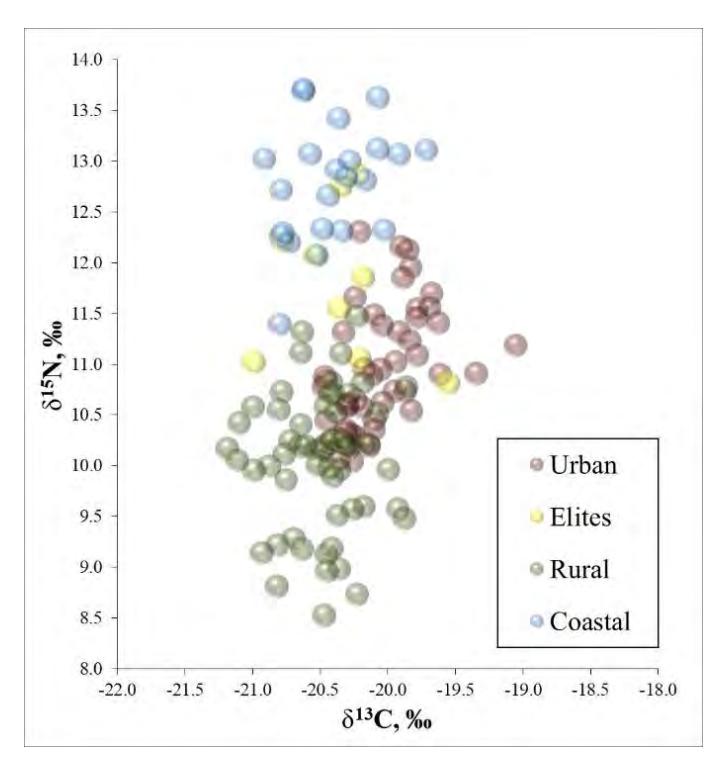
Based on archaeological human bone collagen analysis, the influence of biological factors (men-women); the importance of diachronic factors (I – II millennia); the influence of technological factors (agricultural development) factors; as well as the importance of social and cultural factors (dietary characteristics of rural, urban people, social elites) on the distribution of their stable isotope values were determined.
Therefore, in this presentation, the potential of the stable isotope ratio method will be exemplified by the modern and archaeological investigations.