Energy has always been a common concern of the world, especially nowadays. Renewable energy sources could solve not only economical but also environmental problems such as pollution. However, the intermittency of energy production is one of the main drawbacks of sustainable electricity and requires efficient, low-cost storage systems. Na-ion rechargeable batteries (SIBs) are expected to be a more preferred choice for large-scale energy storage due to the natural abundance and low cost of sodium in comparison with well-known Li-ion batteries [1].
Variety of Na-based materials belonging to three main families: layered oxides, polyanions, and Prussian blue analogous have been studied as electrode materials for SIBs. Prussian blue analogous (PBA) receive the most extensive attention due to their excellent redox properties and relatively high standard potential. The open three-dimensional cage-like structure exhibits wide channels allowing an insertion of wide range of intercalation ions including sodium. Its preparation is simple, low-cost (e.g. co-precipitation, which is easily scalable) and uses abundant and non-toxic elements. The general chemical formula for PBA can be expressed as AxM'[M(CN)6]1-y·zH2O, where Ax is an alkaline metal and M & M' are transition metal cations. Depending on a transitional metal oxidation state, PBA could be divided into three groups: Prussian Green (PG, fully oxidized), Prussian Blue (PB, mixed-state) and Prussian White (PW, fully reduced). PW typically assumes a monoclinic structure in a hydrated form or a rhombohedral structure in an anhydrous state [2-4].
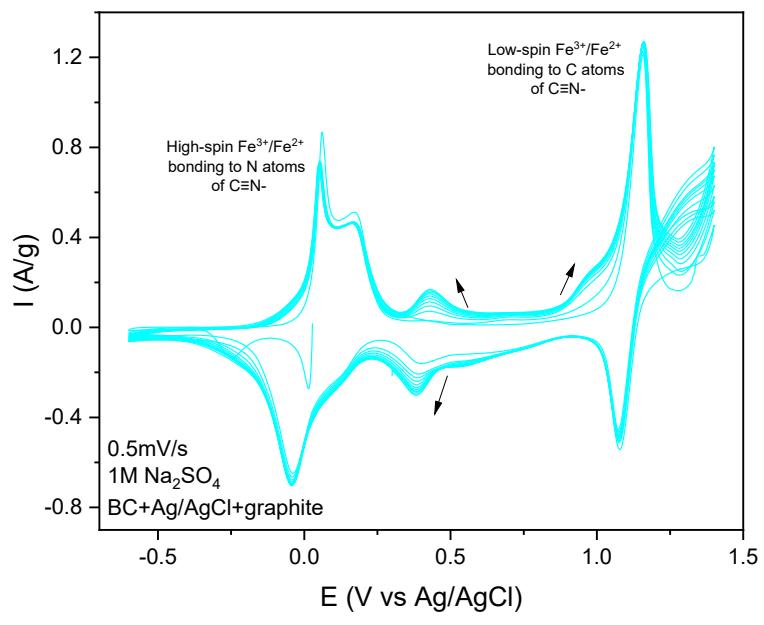
In this investigation, we prepared Na2-xFe[Fe(CN)6]·yH2O in pure monoclinic PW and cubic PB phases via co-precipitation synthesis method by varying the precursors, amounts of them and pH. The structure and morphology of prepared materials were characterized by X-ray diffraction, scanning electron microscopy and thermogravimetric analysis. The electrochemical properties of prepared electrodes were investigated by cyclic voltammetry (Fig. 1) and charge/discharge galvanostatic cycling using different aqueous electrolytes.