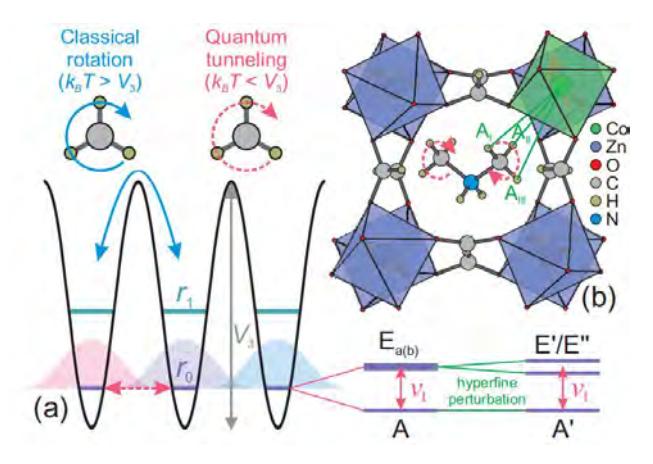
At high temperature, methyl group exhibits classical reorientation dynamics around its symmetry axis, while at lower temperatures, it acts as a quantum rotor exhibiting rotational quantum tunneling, which is highly sensitive to a local methyl group environment (Fig. 1a). Recently, we observed this effect using pulsed electron paramagnetic resonance (EPR) in two dimethylammonium containing hybrid perovskites doped with paramagnetic Mn2+ ions [1].
In this work, we investigate the feasibility of using a fast-relaxing Co2+ paramagnetic center to study the methyl group tunneling in dimethylammonium zinc formate [(CH3)2NH2][Zn(HCOO)3] (Fig. 1b) hybrid perovskite using a multifrequency EPR experiments. Our pulsed EPR experiments reveal magnetic field independent electron spin echo envelope modulation (ESEEM) signals, which are assigned to the methyl group tunneling. The extracted tunnel frequency of 1.84 MHz from the experimental data is used in density operator simulations, which allows us to calculate the rotational barrier of the methyl groups. The comparison of these results [2] with the previously reported Mn2+ [1] case shows that our approach can detect very small changes in the local methyl group environment opening pathway for a new spectroscopic tool.