
The function of the skin is to provide a protective barrier against mechanical, thermal and physical injury, and hazardous substances. Different types of medical dressings are used to facilitate and accelerate wound healing. Bioactive dressings are mainly made from natural or artificial biomaterials (collagen, keratin, etc.) and ensure biocompatibility and non-toxicity. Bioactive dressings initiate the synthesis of fibroblasts, accelerate endothelial migration, and determine more rapid wound healing. Their effectiveness can be enhanced by biologically active additives such as extracts of various medicinal plants. Frequently, herbal extracts alone do not have sufficient antibacterial activity. Their effect on wound healing can be enhanced by addition of silver nanoparticles synthesized using such herbal extracts [1]. For wound healing suitable high surface porosity nonwoven fabric, which ensures moisture and air perviousness, can be obtained by electrospinning. Due to its high specific surface area, electrospun nonwoven fabric can absorb a large amount of wound secreted exudate and protect wound from dehydration [2,3].
The aim of this research was to study the structure and antibacterial activity of electrospun keratin based nonwoven materials modified with biosynthesized silver nanoparticles.
Polyethylene oxide (PEO) and the powder of hydrolyzed keratin (KH) were used to prepare water-based compositions for electrospinning. "Green" silver nanoparticles (AgNPs), synthesized using Calendula officinalis and Matricaria chamomilla blossoms extracts were chosen. Herbal extracts alone showed slight antibacterial activity against Gram-positive bacteria (tested Gram-negative bacteria were resistant to used herbal extracts), while, biosynthesized AgNPs had a pronounced antibacterial effect against tested pathogenic bacteria strains. A small amount of biosynthesized AgNPs dispersion (5%) only slightly decreases the viscosity of the keratin hydrolysate, but higher amount of dispersion (c=15%) markedly reduces hydrolysate viscosity (down to 43 %) and conductivity (down to 3.5%). These parameters affect the diameter of the electrospun keratin nano-microfibers (Fig. 1).
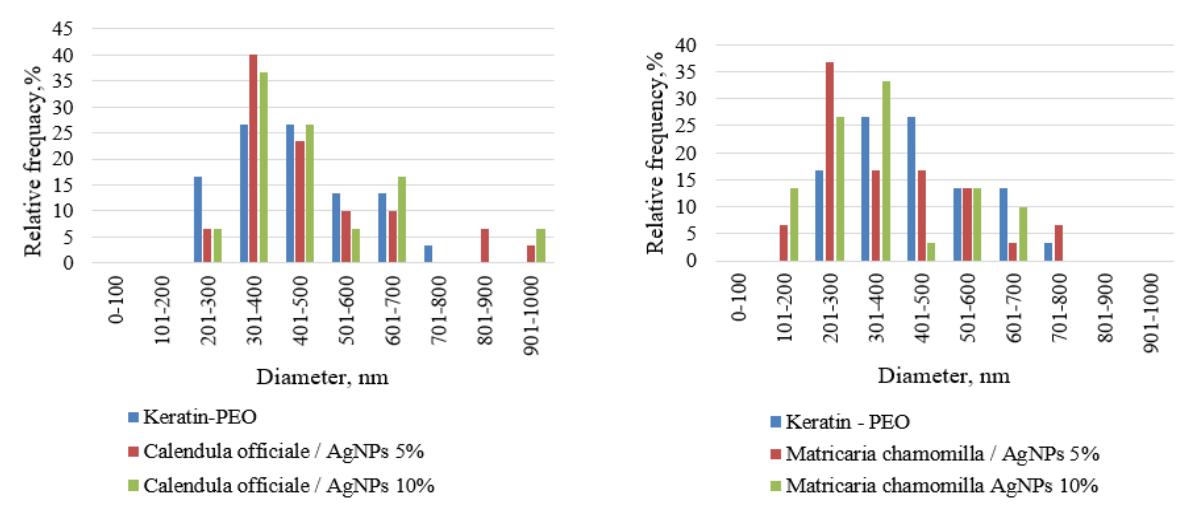
Nano-microfibers diameter and its distribution depend on the amount of herbal extract additives. While 5-10 % of biosynthesised AgNPs have no significant effect on the morphology of the nonwoven material, 15 % additives significantly reduce the viscosity of the composition and make it unsuitable for the electrospinning of nano-microfibres. Thus, keratin solution with a viscosity greater than 170 mPa·s should be used for mats electrospinning.