
The black carbon (BC) mass concentration values for urban areas are not available from standard air quality monitoring networks in many countries because BC is not currently regulated by the EU Air Quality Directive or WHO [1][2]. The urban environments are very complex due to the different emission sources and their emission activities; therefore, a combination of mobile and stationary measurements allows for a better understanding of the dynamics of BC, whose spatial variation is larger than that of PM2.5—the EU air quality standard. In this study, real-time measurements of BC mass concentrations were performed in an office and on a daily commute to assess work-related personal exposure to BC deposition in the lungs of a participant. The study was conducted in Vilnius, Lithuania, in the spring of 2022. Mobile measurements at the street level showed that the BC mass concentrations were the highest during peak hours, reaching up to 7.14 μg/m3 at hotspots. The hourly mean of the BC mass concentration in March 2022 at the urban background station ranged from 0.30 to 9.01 μg/m3, with traffic-related BC (BCtr) accounting for 66% of the total BC mass concentration.
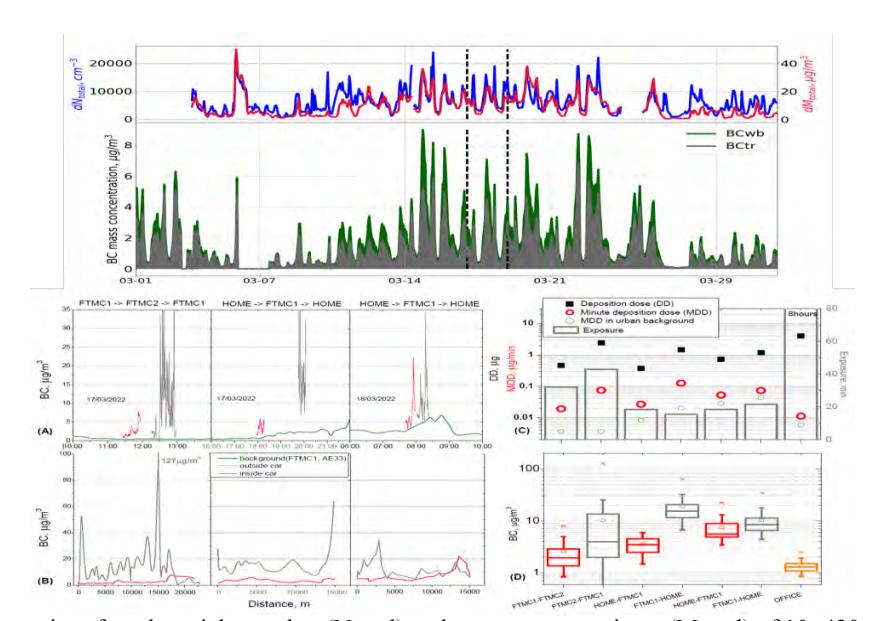
The results of the multi-path particle dosimetry model show that the minute deposition dose of BC (MDDBC) during the working day (including during commuting and office hours) was the highest in the morning rush hour at 52 ng/min and in the evening at 26 ng/min, demonstrating the influence of traffic exhaust emissions on aerosol particles, especially on fine particles. Significant differences were found between the MDDBC in the office and a vehicle. The deposition dose indicates that daily BC exposure in vehicles during commuting could account for up to one-third (2.5) of the work-related exposure of office workers, depending on how much time they spend commuting to work The distribution of the MDDBC in the human respiratory tract had a maximum in the pulmonary region ranging from 5.1 ng/min in the office to 19.9 ng/min in the car during the morning drive.