Optical parametric generators (OPGs) are convenient and easy devices to obtain a wide laser radiation spectrum tuning in the IR region, so they are widely used in fields such as spectroscopy, gas detectors, etc [1,2]. Some applications require subnanosecond (300 ps – 1 ns) duration tunable frequency laser radiation, but such OPGs are difficult to realize, due to laser induced damage threshold (LIDT) of the nonlinear medium, which for subnanosecond pulses in some materials is lower than parametric generation threshold. Due to high nonlinearity, OPGs are often realized with periodically poled crystals where quasi-phase matching is used. In a fan-out grating design, the effective grating period (and quasi-phase matching conditions) changes continuously with the crystal width, allowing a continuous spectrum tuning simply by translating (laterally displacing) the crystal. This tuning is more convenient, faster and more stable than temperature tuning.
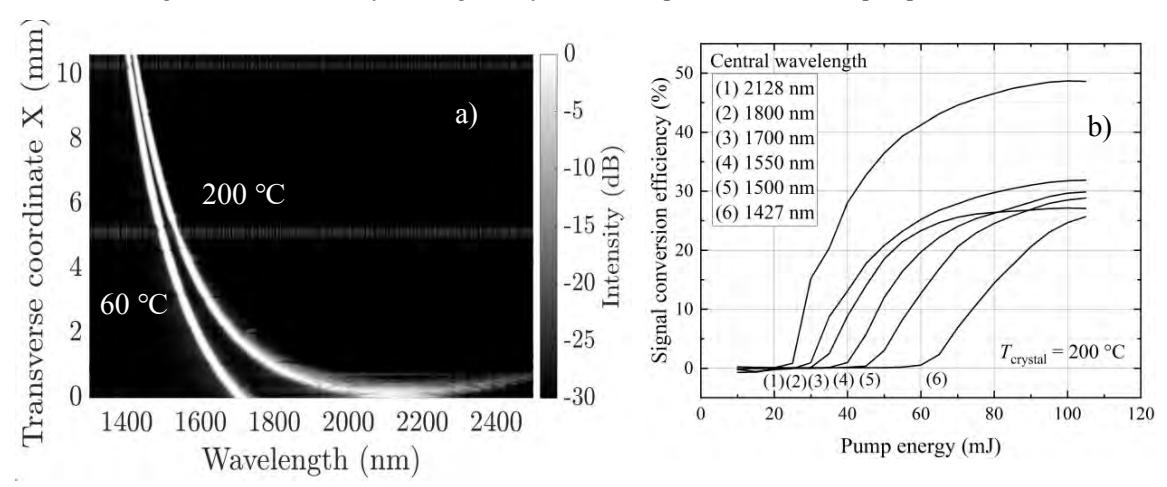
In this report we investigate a subnanosecond optical parametric generator with a fan-out grating design in 2.5 cm length 5% magnesium-oxide-doped periodically poled lithium niobate (MgO:PPLN) crystal, which grating period changes continuously from 27.5 μm to 31.6 μm. OPG was pumped by a passively Q-switched Nd:YAG microlaser that generates 1064 nm 520 ps pulses with power up to 1 W and a repetition rate of 1 kHz. With such grating periods in the fan-out design, we achieved continuous spectral tuning for signal from 1420 nm to 2128 nm when the crystal temperature was 200 °C (Fig. 1 (a)). The maximum conversion efficiency of 48.6% was achieved in the degenerate regime (Fig. 1 (b)). The influence of pump focusing conditions for signal energy and spectral characteristics was determined. We also showed that with a fan-out grating design, it is possible to change the central wavelength and spectral width of the generated radiation by rotating the crystal with respect to the incident pump beam.