
Interaction of photoactive compounds with light by absorption involves excitation into higher energy levels. Excitation energy can be either dissipated among vibrational modes of molecule or radiated in the form of photons. Energetically accessible conical intersections (CI) provide funnel between any two (or more) electronic states for non-radiative excitation energy dissipation. Since conical intersections are not single points on potential energy surface, but rather 3N – 8 dimensional seams, configuration space must be thoroughly explored, lowest energy structures and their accessibility must be assessed. Accessibility of these CIs can be related to energy barrier height (TS, Fig. 1), which must be overcome to reach CI. Height of energy barrier determines the rate of non-radiative process. Minimum energy pathways (MEP) from Franck-Condon (FC) region to conical intersection can be used to determine CI accessibility and make predictions about photophysical properties of molecules in study.
Molecules bearing BODIPY fragment are model photoactive compounds with wide applications in fluorescence imaging and biosensing [1, 2]. Accessibility of conical intersection for BODIPY compounds is affected by nature of rotor group at 8 position (Fig. 1) and overall BODIPY fragment substitution [2]. The aim of this study is to determine minimum energy path for different BODIPY compounds and predict their photophysical properties.
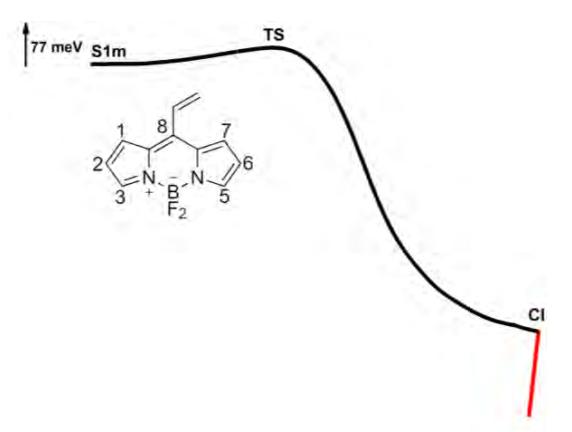
In this work, minimum energy pathways from FC region to CI in excited state (S1) and ground state (S0) were calculated for several BODIPY compounds by Nudged Elastic Band (NEB) method implemented in Orca 5.0.3 software. All stationary points on potential energy surface were optimized and NEB calculations were done at (TD-)DFT/PBE0 level of theory using cc-pVDZ basis set. In order to confirm that optimized CIs are involved in non-radiative relaxation of BODIPY, energy barrier heights for transition from excited state minimum (S1m, Fig. 1) to conical intersection were calculated for all molecules. The computed energy barriers qualitatively agree with empirical data i.e. the higher energy barrier the higher experimental quantum efficiency of molecule is. This trend confirms that optimized conical intersection structures were indeed involved in radiationless relaxation. The main findings of this study suggest that despite introduction of bulky phenyl groups at 2, 6 positions at BODIPY fragment and methyl groups at 1, 3, 5, 7 BODIPY fragment positions accessibility to conical intersection was similar for all compounds in study.