In many different fields of science, analysis of physical problems using analytical mathematical models can be difficult. Inclusion of every single possible interaction causes mathematical equations to become too complicated, even for the best supercomputers to this day. In spintronics, effects such as magnetoresistance (MR) heavily depend not only on the selection of materials, but also on the magnetisation process [1][2], latter of which can be quite difficult to grasp even utilizing quantum mechanics. To simplify the problem, one way to analyse microscopic magnetisation processes is by using the Ising model [3], where an arbitrary volume is divided into some number of unit cells that have quantized spin (in the most common case, having spin 1/2 or -1/2). These cells then interact with neighbouring cells and depending on the exchange coupling constant, cells either try to orient their spin in one direction or in opposite directions. Such model is usually solved using Monte Carlo methods, where the probability for a cell to change its spin value can be calculated using Boltzmann statistics. With this model one can analyse phase transition and magnetic hysteresis dynamically. The Ising model is also an approximation of the classical Heisenberg model and only one spin projection is considered.
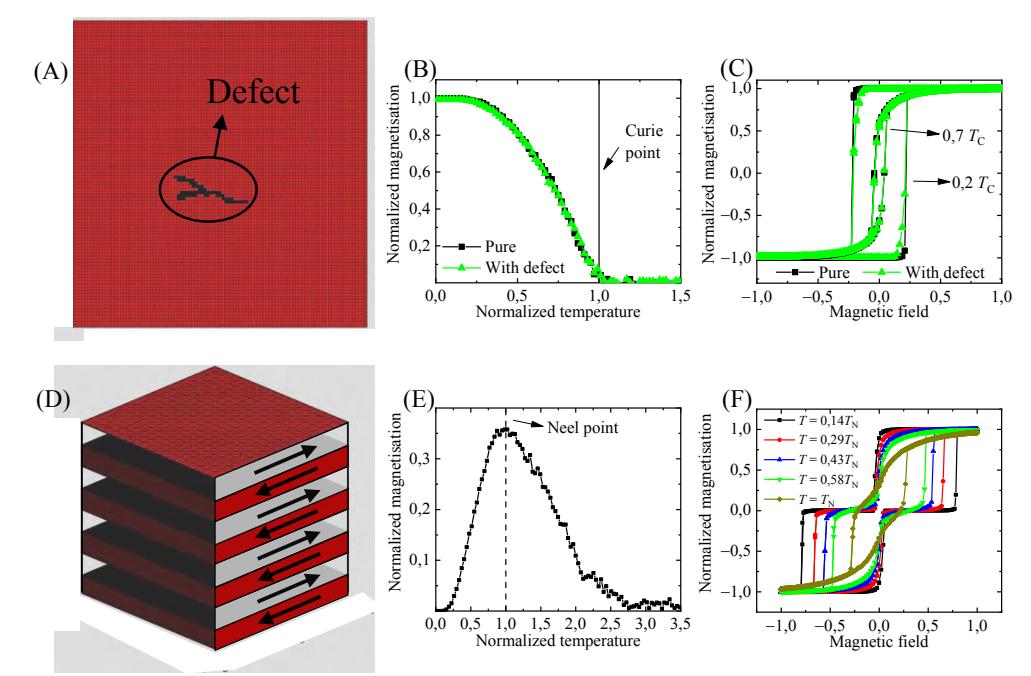
In this work, some common examples are analysed, such as defects in ferromagnets and artificial antiferromagnet configuration using the Ising model (Fig. 1). By changing exchange coupling, interacting neighbour count, volume size and adding macroscopic effects, such as demagnetizing field or anisotropy, changes in phase diagrams and magnetic hystereses are explored.