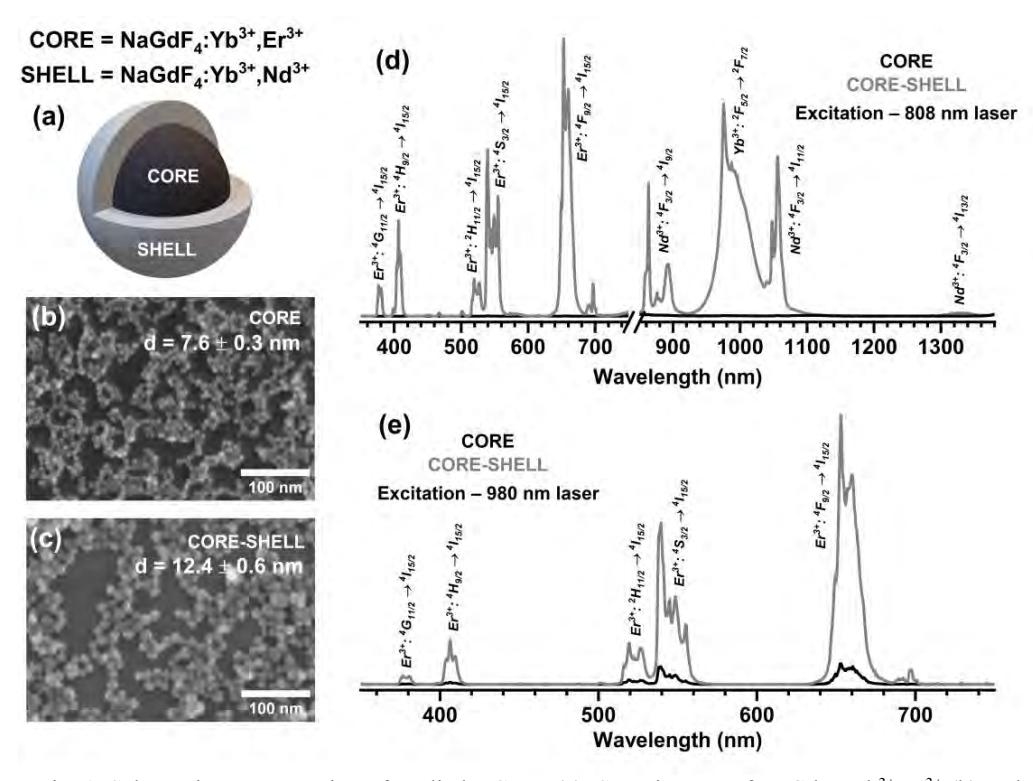
There is an undeniable demand for the development of multifunctional materials that can be used for both bioimaging and drug delivery. Rare-earth doped upconverting nanoparticles (UCNPs) have shown great promise due to their unique optical properties, such as the absence of blinking, excitation with low energy radiation, and high emission signal-to-noise ratio [1]. However, there are several issues that need to be addressed before these materials can be widely used for theranostics. One issue is the extensive heating of samples using 980 nm lasers. To address this issue, researchers have developed approaches to shift the near-infrared (NIR) excitation to 808 nm by co-doping the UCNPs matrix with Yb3+ and Nd3+ pair [2]. This is beneficial because the 808 nm wavelength falls within the first biological window, where water absorbance is approximately 90-95% lower; therefore, 808 nm laser radiation can penetrate deeper into biological tissues compared to the commonly used 980 nm wavelength laser radiation [3].
In this study, we describe the synthesis of well-defined UCNPs with a complex core-shell composition that can be excited using both 808 and 980 nm laser radiation. Optical and temperature-sensing properties of these UCNPs are evaluated in detail. In addition, we investigate the colloidal stability of the UCNPs in aqueous and biological media, as well as the viability of human kidney cells (HEK 293t) after exposure to UCNPs' solutions of different concentrations. The potential use of these materials as MRI contrast agents is explored as well.