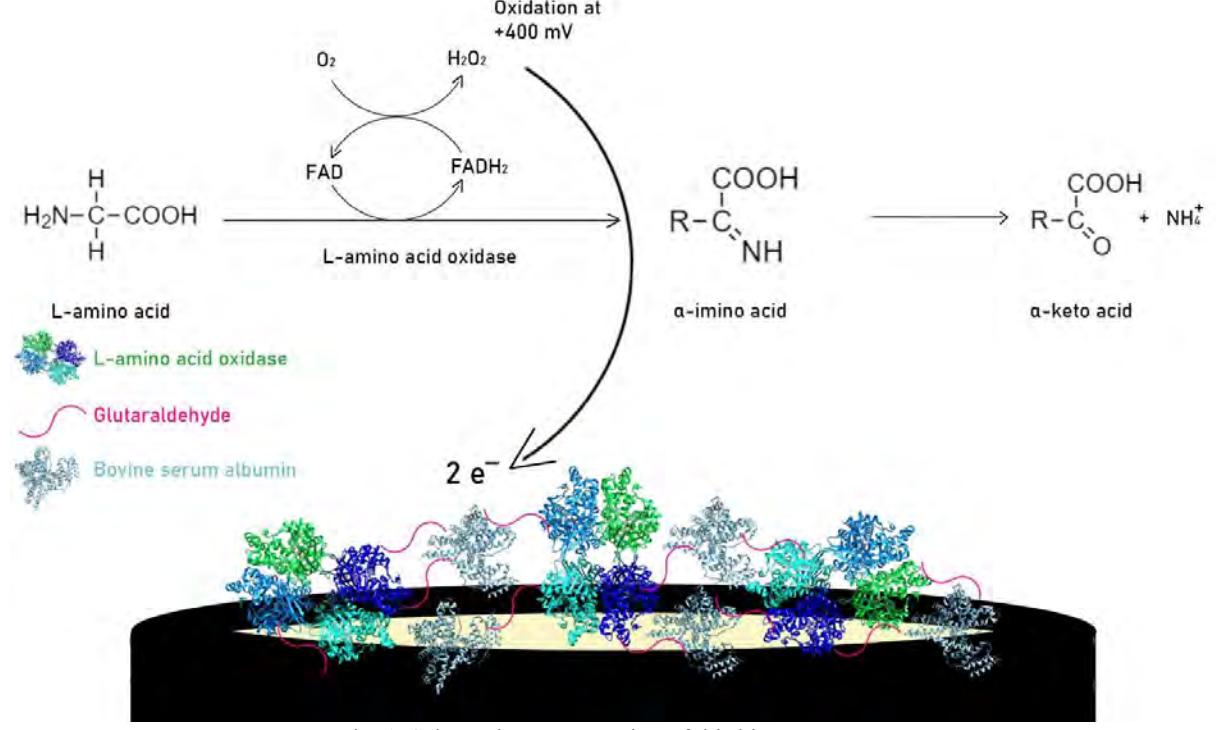
Amino acids are of great interest due to their key role in human health. Increased levels of total plasma L-amino acids can be related to fructose intolerance, kidney failure, and ketoacidosis [1]; while lowered levels of total amino acids plasma can be a sign of nephrotic syndrome, Huntington's disease, rheumatoid arthritis and also fever [1]. Hence, the determination of L-amino acids in bodily fluids is of great importance. Enzymes are biocatalysts that increase the rate of biochemical reactions. Therefore, they are commonly used in the field of biosensors in the development of enzymatic biosensors. Due to the long history of enzyme-based biosensors, various biosensors can be produced on the basis of enzyme specificity.
The aim of this research was to develop an L-amino acids biosensor using immobilized L-amino acid oxidase from Crotalus adamanteus. L-amino acid oxidase is a flavoenzyme that catalyzes the oxidative deamination of L-amino acids to α-keto acids producing ammonia and hydrogen peroxide [2]. The resulting hydrogen peroxide diffuses to the surface of the working electrode, on which the electrochemical oxidation of hydrogen peroxide occurs. The immobilization of L-amino acid oxidase was achieved using bovine serum albumin, as a stabilizing agent and glutaraldehyde, as a cross-linking agent. The electrochemical performance of the sensor for detecting L-amino acids was investigated by cyclic voltammetry and chronoamperometry. The response to L-amino acids was linear in the range of 0.1 mM to 1 mM, correlation coefficient was 0.9998, sensitivity was 7073 μA mM-1 cm-2, calculated limit of detection was 0.1 mM. To add more, after 40 days the biosensor still demonstrated more than 70 % of the initial activity indicating a good overall stability. The developed biosensor was tested on artificial and real samples and demonstrated fast assessment in analyzing amino acid levels in diluted serum samples obtained from patients undergoing renal replacement therapy.