The presence of organic pollutants in wastewater negatively impacts people and ecosystems [1]. Among advanced oxidation processes used for wastewater treatment, photocatalytic degradation of pollutants using solar light has been attracting increasing attention recently [2]. Bismuth vanadate (BiVO4) is a promising semiconductor photocatalyst due to low production cost, low toxicity, high photostability, resistance to photo-corrosion and narrow band gap with a good response to visible-light excitation [3], however BiVO4 photoanodes have not yet achieved the desired performance to make them suitable for practical applications [4] .
In the present work the influence of polyvinyl alcohol (PVA) used in sol-gel process as well as the number of deposition cycles (equivalent to thickness of the layer) on the photoelectrochemical (PEC) activity of BiVO4 coatings was investigated. BiVO4 films were deposited on fluorine doped tin oxide (FTO) substrate using dip-coating technique. Crystalline structure and morphology of coatings were analyzed using X-ray diffraction (XRD) analysis and scanning electron microscopy (SEM), respectively. The PEC properties of coatings were evaluated using cyclic voltammetry (CV) and electrochemical impedance spectroscopy (EIS).
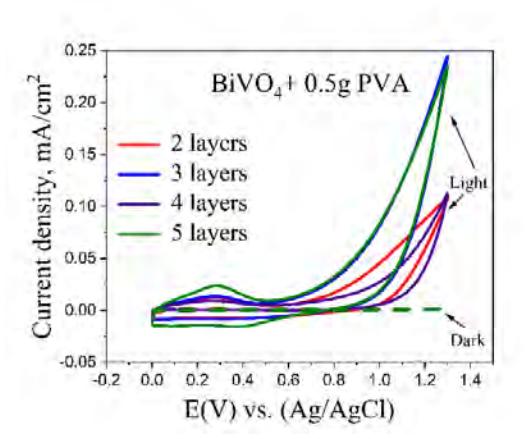
Fig. 1. Cyclic voltammograms of BiVO4 electrodes with different number of layers and PVA amount used in the synthesis. Experiments were performed in 0.5 M Na2SO4 solution; Reference electrode: Ag/AgCl; potential scan rate 50 mV/s. Light intensity 100mW/cm2.
Obtained results revealed, that amount of PVA used in the sol-gel process has significant influence on PEC performance of the coatings. Smaller amount of PVA (0.5 g instead of 0.7 g) was beneficial for PEC activity and photoanodic current increased with the number of deposition cycles (Fig. 1). The results on PEC production of reactive species in the electrolytes of various composition as well as the efficiency of decomposition of organic compounds will be presented at the conference.
Acknowledgments: This project has received funding from the Research Council of Lithuania (LMTLT), agreement No S-PD-22-2
[1] Y. Wen, G. Schoups, and N. van de Giesen, "Organic pollution of rivers: Combined threats of urbanization, livestock farming and global climate change," Sci Rep, vol. 7, no. 1, p. 43289, Feb. 2017, doi: 10.1038/srep43289.
[2] S. Bakhtiarnia, S. Sheibani, A. Billard, H. Sun, E. Aubry, and M. A. P. Yazdi, “Enhanced photocatalytic activity of sputter-deposited nanoporous BiVO4 thin films by controlling film thickness," J Alloys Compd, vol. 879, p. 160463, Oct. 2021, doi: 10.1016/j.jallcom.2021.160463.
[3] M. A., M. J., M. Ashokkumar, and P. Arunachalam, "A review on BiVO4 photocatalyst: Activity enhancement methods for solar photocatalytic applications," Appl Catal A Gen, vol. 555, pp. 47–74, Apr. 2018, doi: 10.1016/j.apcata.2018.02.010.
[4] L. Xia, J. Li, J. Bai, L. Li, S. Chen, and B. Zhou, "Bivo4 photoanode with exposed (040) facets for enhanced photoelectrochemical performance," Nanomicro Lett, vol. 10, no. 1, 2018, doi: 10.1007/s40820-017-.