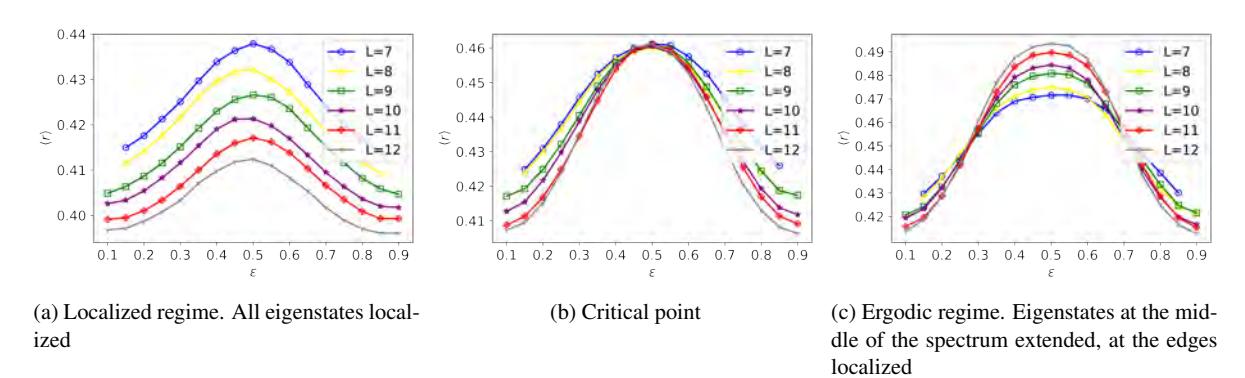
It is currently of great scientific interest to study generic toy models of ergodicity breaking transition, in search for many-body localized (MBL) phase that survives in the thermodynamic limit [1]. Quantum sun model [2], which describes ergodic quantum dot coupled to particles with spin-1/2, is example of such toy model. Numerical simulations reveal that this model exhibits transition between ergodic and MBL phase and exactly at the transition properties of the system do not depend on the system size, suggesting stability of this transition in the thermodynamic limit.
We extend analysis of [2] by considering a variant of this model with a conserved projection of the total spin $\hat{S}_{tot}^z$ and analysing the biggest symmetry sector. This makes the model more feasible for an experimental implementation using cold-atom platforms, as $\hat{S}_{tot}^z$ corresponds then to the particle number. We find that all hallmarks of the original model, like a universal shape of the spectral form factor independent of system size, are preserved in this variant with conservation up to systems with 24 spins. The biggest studied system sizes are calculated using Polynomially Filtered Exact Diagonalization (POLFED) algorithm [3]. Moreover, model with conservation exhibits the presence of the mobility edge (i.e. a boundary between localized and extended states in the spectrum) in the ergodic phase, which is observed by calculating energy spacing ratio $r_n$:
$$H|\psi_n\rangle = E_n|\psi_n\rangle, \quad \delta E_n = E_{n+1} - E_n, \quad r_n = \min\left\{\frac{\delta E_n}{\delta E_{n-1}}, \frac{\delta E_{n-1}}{\delta E_n}\right\} = \frac{\min\{\delta E_n, \delta E_{n-1}\}}{\max\{\delta E_n, \delta E_{n-1}\} }\tag{1}$$and averaging it over many disorder realisations in different energy windows around rescaled energy $\varepsilon = (E - E_{\min})/(E_{\max} - E_{\min})$, as depicted on Fig. 1.