
The CMS or Compact Muon Solenoid experiment at CERN Large hadron collider (LHC) is a detector, designed to study various physical phenomena of colliding particles. One important part of the CMS detector is its Inner Tracker, which is responsible for measuring LHC produced particle trajectories. The Inner Tracker is made up of several layers of silicon pixels detectors to achieve high accuracy measurements.
To achieve better and more precise results, a new High Luminosity LHC (HL-HLC for short) upgrades are to be implemented by 2029 [1]. As a result, the CMS detector is also undergoing so called Phase-2 upgrade, to prepare it for the new collider.
HL-LHC will greatly increase its luminosity, meaning the currently achievable one billion collisions per second will increase to ten billion collisions [2]. So, the main goal of the upgrades is to increase the number of channels and improve the efficiency of the detectors. Therefore, the current detectors need to be replaced by ones with smaller pixels and higher granularity. Another essential factor is to make the parts much more resistant to radiation since the increased luminosity will do 10 times more radiational damage to the detectors than currently. The last important detail is to improve the read-out electronics, for the vastly increased rate of information.
The mentioned upgrades will provide several key benefits. Firstly, the higher number of channels will increase the effectiveness of the tracker, it will allow reconstruction and analysis of more particles. Furthermore, the improved pixel detector granularity is essential to measure and understand the properties of particles produced in LHC collisions more precisely.
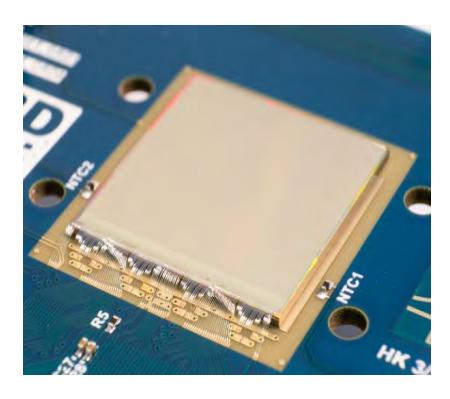
Lithuanian scientists are working with the CMS Inner Tracker upgrade group to perform pixel detector prototype testing. The study to be presented focuses on calibration and system tests on RD53B CMS (also called CROC) pixel chip prototypes, which are developed for the Phase-2 CMS upgrade. We further explore and, in more detail, explain and present the work being completed in CERN.
This presentation will go more in-depth about the tests performed at CERN, using a radioactive source on a CROC chip with a sensor to study its trigger latency characteristics.