Photosynthesis is one of the most important processes on Earth. The most efficient organisms that carry out photosynthesis are land plants or higher plants. In thylakoid membrane of chloroplasts there are two systems that carry out photosythesis – Photosystem I (PSI) and Photosystem II (PSII), both with their own light harvesting complexes - LHCI and LHCII. PSI is the most efficient light-to-energy conversion apparatus with quantum yield almost equal to 1 [1]. One of the conditions needed for high efficiency is very fast energy transfer between molecules in light harvesting complex. The excitation dynamics in LHCI is highly affected by the charge-transfer (CT) states that occure between two or more pigments (chlorophylls or carotenoids). Some sites in which CT states occure in LHCI are known, however, they do not completely explain the spectral properties of this antenna, such as the red-shifted peak in fluorescence spectrum.
Light-harvesting complex of PSI absorbs and emits light at the longest wavelengths compared to other pigment-protein complexes. In plants light harvesting antenna of PSI is composed of four species of LHCI complexes. They all have very similar structure, however, their spectral properties are different. The most red-shifted peak (at around 733 nm) is observed in the fluorescence spectrum of Lhca4 light harvesting sub-complex [2].
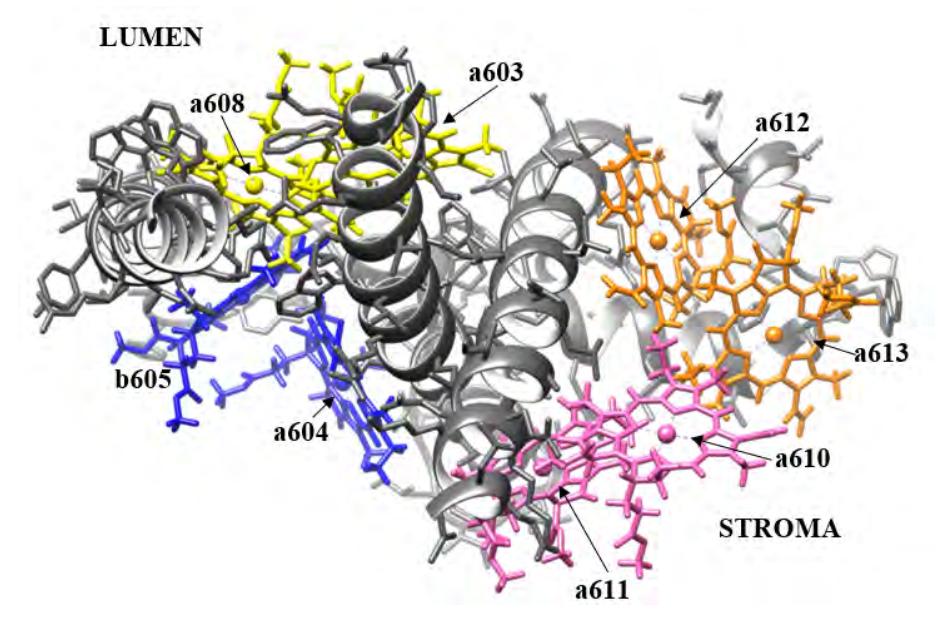
The structure of Lhca4 was obtained as the 4th chain of PSI supercomplex structure, freely accessible on Protein Data Bank (PDB) [3]. In order to find possible locations of the charge-transfer states in Lhca4, we examined chlorophyll dimers that have the shortest (up to 12 Å) Mg-Mg distance. After performing geometry optimization of selected individual chlorophylls, whose phytyl tail was removed for computing time saving reasons, they were mapped on the Lhca4 structure to form dimers (as shown in Fig. 1). We then examined the excited states properties of all selected dimers in vacuum. An excited state is considered to be a charge-transfer state if it exhibits relatively small absolute value of transition from the ground to the excited state dipole moment and large static electric dipole moment value. The sum of partial atomic Mulliken charges for a dimer in charge-transfer state is approximately equal to 1 for one pigment and to -1 for another. Therefore, it was also used to indicate the CT states. After analyzing the data of 12 chosen dimers and their 8 lowest excited states, 19 charge-transfer states were located.