
Yttrium Aluminum Garnets (Y3Al5O12, YAGs) are materials with very suitable properties for lightning technologies. Their transparency, and high chemical and heat resistance make them a powerful basis for solid-state lightning applications. To do this, YAGs must be doped with optically-active ions of similar size to replace some of the Yttrium and Aluminum ions. The study of different doping elements and concentrations is of great importance to produce new materials with the desired optical profile, which allows the development of more powerful and precise devices for medicine, technological or lightning applications. Solid-state Nuclear Magnetic Resonance (NMR) is a very powerful experimental method for materials research. It provides information on the local structure at molecular level and defects of the material. This information allows to create structure-optical properties relations.
In this work, YAGs doped with different concentrations of 23Na and 51V were analyzed employing 27Al, 23Na and 51V Magic Angle Spinning (MAS) NMR experiments. Multiple Quantum MAS technique was used to resolve overlapping signals from different chemical moieties. NMR was found to be very beneficial as crystalline and amorphous moieties formed during the synthesis of these novel garnets were detected. In contrary, XRD (X-ray diffraction) analysis which was performed provided information only on the crystalline phases.
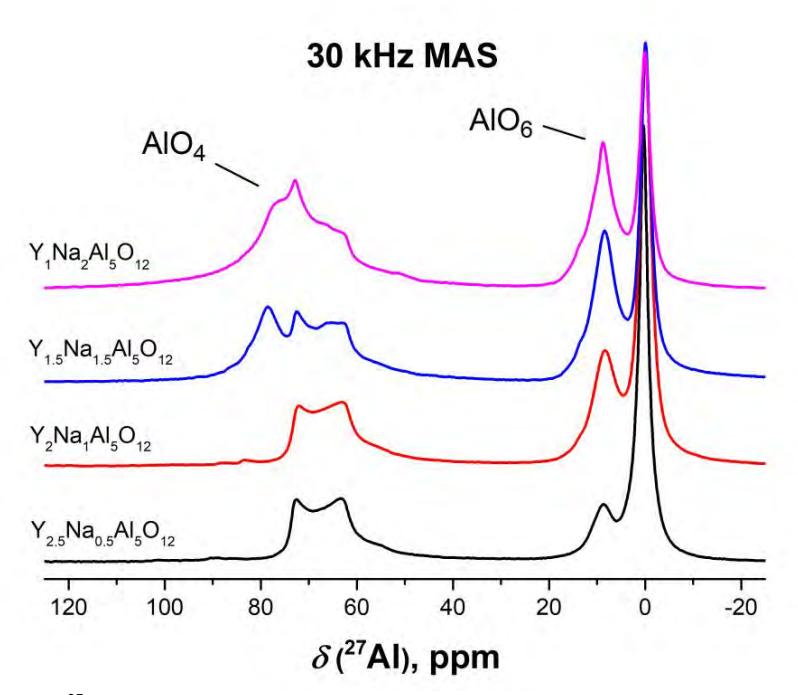
In Fig. 1, we can observe the 27Al NMR spectra obtained for four YAG samples containing different doping levels of Na. It can be seen that the 4th-coordinated Aluminum peak changes with increasing concentrations of Na; mainly due to the apparition of other phases such as Al2O3, YAP and YAlO3.
A better understanding of the structure and properties of the studied materials will allow for more methodic practical testing in applications; as oftentimes even slight variations in concentration can change the optical properties drastically. Through this research, we aim to produce an NMR characterization of these promising families of YAGs to facilitate the advancement of new technologies.