The increasing use of these carbon nanomaterials in a range of industries highlights the necessity to examine their environmental destiny as well as their potential toxicity to living organisms. In a real-world scenario, where the risk of these nanomaterials being developed and accidentally discharged into the environment is quite high, the toxicity of graphene-based nanomaterials must be investigated individually and in combination with other chemicals for a more associated risk differentiation of these materials [1].
The potential short-term impact of graphene oxide (GO) and four common metals (Zn, Cu, Ni, and Cr) in a complex mixture (MIX) on the swimming behaviour of freshwater brown trout (Salmo trutta L.) was examined. Fish juveniles were treated individually in open-field tanks for 2-hours to single and combined exposure of GO (1, 10 and 20 mg L-1) and MIX (Zn2+ – 100, Cu2+ – 10, Ni2+ – 34 and Cr3+/6+ – 10 μg L-1, respectively) solution. MIX was produced in accordance with the maximum-allowable-concentrations (MAC) for certain metals in European rivers and lakes [2].
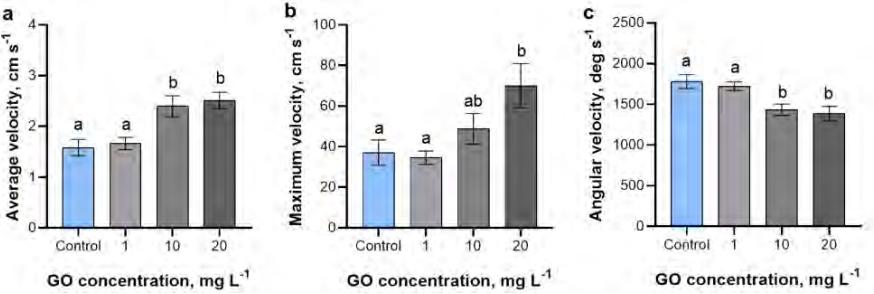
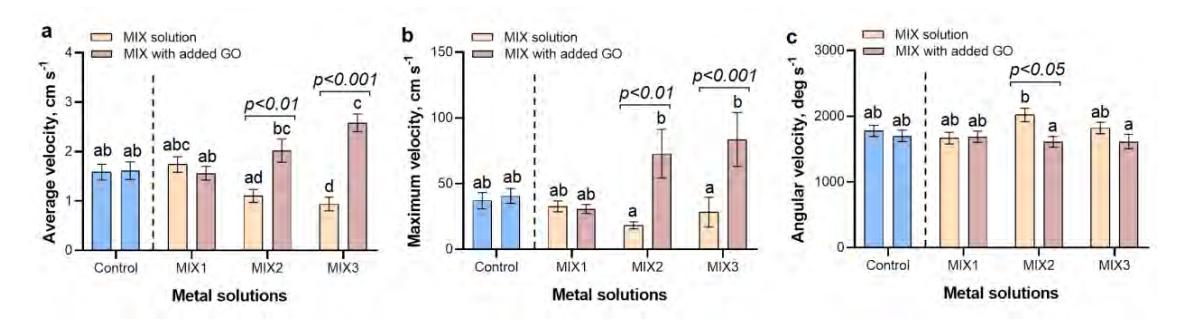
The results (Figure 1 and 2) showed that single and combined GO and MIX treatment had a substantial influence on the behavioural responses of fish juveniles, increasing swimming activity by 19-61%. Fish juveniles exposed to GO and MIX showed opposite responsive tendency, where interaction between GO and MIX intensified the trace elements effects by significantly increasing (from 1.8 to 2.8-fold) swimming activity in juveniles compared to those exposed to MIX. These findings show that GO modulate the toxicity of metal pollutants in complex mixture at the biological scale.